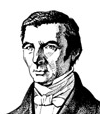
The Book and Author: When a reviewer wishes to give special recognition to a book, he predicts that it will still be read "a hundred years from now." The Law, first published as a pamphlet in June, 1850, is already more than a hundred years old. And because its truths are eternal, it will still be read when another century has passed. Frederic Bastiat (1801-1850) was a French economist, statesman, and author. He did most of his writing during the years just before - and immediately following - the Revolution of February 1848.
- The Law
The law perverted! And the police powers of the state perverted along with
it! The law, I say, not only turned from its proper purpose but made to
follow an entirely contrary purpose! The law become the weapon of every
kind of greed! Instead of checking crime, the law itself guilty of the
evils it is supposed to punish!
If this is true, it is a serious fact, and moral duty requires me to call the attention of my fellow-citizens to it.
- Life is a Gift from God
We hold from God the gift which includes all others. This gift is life - physical,
intellectual, and moral life.
But life cannot maintain itself alone. The Creator of life has entrusted us with the responsibility of preserving, developing, and perfecting it. In order that we may accomplish this, He has provided us with a collection of marvelous faculties. And He has put us in the midst of a variety of natural resources. By the application of our faculties to these natural resources we convert them into products, and use them. This process is necessary in order that life may run its appointed course.
Life, faculties, production - in other words, individuality, liberty, property this is man. And in spite of the cunning of artful political leaders, these three gifts from God precede all human legislation, and are superior to it.
Life, liberty, and property do not exist because men have made laws. On the contrary, it was the fact that life, liberty, and property existed beforehand that caused men to make laws in the first place.
- What is Law?
What, then, is law? It is the collective organization of the individual
right to lawful defense.
Each of us has a natural right - from God - to defend his person, his liberty, and his property. These are the three basic requirements of life, and the preservation of any one of them is completely dependent upon the preservation of the other two. For what are our faculties but the extension of our individuality? And what is property but an extension of our faculties?
If every person has the right to defend even by force-his person, his liberty, and his property, then it follows that a group of men have the right to organize and support a common force to protect these rights constantly. Thus the principle of collective right-its reason for existing, its lawfulness-is based on individual right. And the common force that protects this collective right cannot logically have any other purpose or any other mission than that for which it acts as a substitute. Thus, since an individual cannot lawfully use force against the person, liberty, or property of another individual, then the common force for the same reason-cannot lawfully be used to destroy the person, liberty, or property of individuals or groups.
Such a perversion of force would be, in both cases, contrary to our premise. Force has been given to us to defend our own individual rights. Who will dare to say that force has been given to us to destroy the equal rights of our brothers? Since no individual acting separately can lawfully use force to destroy the rights of others, does it not logically follow that the same principle also applies to the common force that is nothing more than the organized combination of the individual forces?
If this is true, then nothing can be more evident than this: The law is the organization of the natural right of lawful defense. It is the substitution of a common force for individual forces. And this common force is to do only what the individual forces have a natural and lawful right to do: to protect persons, liberties, and properties; to maintain the right of each, and to cause justice to reign over us all.
- A Just and Enduring Government
If a nation were founded on this basis, it seems to me that order would
prevail among the people, in thought as well as in deed. It seems to me
that such a nation would have the most simple, easy to accept, economical,
limited, non-oppressive, just, and enduring government imaginable-whatever
its political form might be.
Under such an administration, everyone would understand that he possessed all the privileges as well as all the responsibilities of his existence. No one would have any argument with government, provided that his person was respected, his labor was free, and the fruits of his labor were protected against all unjust attack. When successful, we would not have to thank the state for our success. And, conversely, when unsuccessful, we would no more think of blaming the state for our misfortune than would the farmers blame the state because of hail or frost. The state would be felt only by the invaluable blessings of safety provided by this concept of government.
It can be further stated that, thanks to the non-intervention of the state in private affairs, our wants and their satisfactions would develop themselves in a logical manner. We would not see poor families seeking literary instruction before they have bread. We would not see cities populated at the expense of rural districts, nor rural districts at the expense of cities. We would not see the great displacements of capital, labor, and population that are caused by legislative decisions.
The sources of our existence are made uncertain and precarious by these state-created displacements. And, furthermore, these acts burden the government with increased responsibilities.
- The Complete Perversion of the Law
But, unfortunately, law by no means confines itself to its proper functions.
And when it has exceeded its proper functions, it has not done so merely
in some inconsequential and debatable matters. The law has gone further
than this; it has acted in direct opposition to its own purpose. The
law has been used to destroy its own objective: It has been applied to
annihilating the justice that it was supposed to maintain; to limiting
and destroying rights which its real purpose was to respect. The law has
placed the collective force at the disposal of the unscrupulous who wish,
without risk, to exploit the person, liberty, and property of others. It
has converted plunder into a right, in order to protect plunder. And it
has converted lawful defense into a crime, in order to punish lawful defense.
How has this perversion of the law been accomplished? And what have been the results?
The law has been perverted by the influence of two entirely different causes: stupid greed and false philanthropy. Let us speak of the first.
- A Fatal Tendency of Mankind
Self-preservation and self-development are common aspirations among all
people. And if everyone enjoyed the unrestricted use of his faculties and
the free disposition of the fruits of his labor, social progress would
be ceaseless, uninterrupted, and unfailing.
But there is also another tendency that is common among people. When they can, they wish to live and prosper at the expense of others. This is no rash accusation. Nor does it come from a gloomy and uncharitable spirit. The annals of history bear witness to the truth of it: the incessant wars, mass migrations, religious persecutions, universal slavery, dishonesty in commerce, and monopolies. This fatal desire has its origin in the very nature of man in that primitive, universal, and insuppressible instinct that impels him to satisfy his desires with the least possible pain.
- Property And Plunder
Man can live and satisfy his wants only by ceaseless labor; by the ceaseless
application of his faculties to natural resources. This process is the
origin of property.
But it is also true that a man may live and satisfy his wants by seizing and consuming the products of the labor of others. This process is the origin of plunder.
Now since man is naturally inclined to avoid pain-and since labor is pain in itself-it follows that men will resort to plunder whenever plunder is easier than work. History shows this quite clearly. And under these conditions, neither religion nor morality can stop it.
When, then, does plunder stop? It stops when it becomes more painful and more dangerous than labor. It is evident, then, that the proper purpose of law is to use the power of its collective force to stop this fatal tendency to plunder instead of to work. All the measures of the law should protect property and punish plunder.
But, generally, the law is made by one man or one class of men. And since law cannot operate without the sanction and support of a dominating force, this force must be entrusted to those who make the laws.
This fact, combined with the fatal tendency that exists in the heart of man to satisfy his wants with the least possible effort, explains the almost universal perversion of the law. Thus it is easy to understand how law, instead of checking injustice, becomes the invincible weapon of injustice. It is easy to understand why the law is used by the legislator to destroy in varying degrees among the rest of the people, their personal independence by slavery, their liberty by oppression, and their property by plunder. This is done for the benefit of the person who makes the law, and in proportion to the power that he holds.
- Victims Of Lawful Plunder
Men naturally rebel against the injustice of which they are victims. Thus,
when plunder is organized by law for the profit of those who make the law,
all the plundered classes try somehow to enter-by peaceful or revolutionary
means-into the making of laws. According to their degree of enlightenment,
these plundered classes may propose one of two entirely different purposes
when they attempt to attain political power: Either they may wish to stop
lawful plunder, or they may wish to share in it.
Woe to the nation when this latter purpose prevails among the mass victims of lawful plunder when they, in turn, seize the power to make laws!
Until that happens, the few practice lawful plunder upon the many, a common practice where the right to participate in the making of law is limited to a few persons. But then, participation in the making of law becomes universal. And then, men seek to balance their conflicting interests by universal plunder. Instead of rooting out the injustices found in society, they make these injustices general. As soon as the plundered classes gain political power, they establish a system of reprisals against other classes. They do not abolish legal plunder. (This objective would demand more enlightenment than they possess.) Instead, they emulate their evil predecessors by participating in this legal plunder, even though it is against their own interests.
It is as if it were necessary, before a reign of justice appears, for everyone to suffer a cruel retribution-some for their evilness, and some for their lack of understanding.
- The Results of Legal Plunder
It is impossible to introduce into society a greater change and a greater
evil than this: the conversion of the law into an instrument of plunder.
What are the consequences of such a perversion? It would require volumes to describe them all. Thus we must content ourselves with pointing out the most striking.
In the first place, it erases from everyone's conscience the distinction between justice and injustice.
No society can exist unless the laws are respected to a certain degree. The safest way to make laws respected is to make them respectable. When law and morality contradict each other, the citizen has the cruel alternative of either losing his moral sense or losing his respect for the law. These two evils are of equal consequence, and it would be difficult for a person to choose between them.
The nature of law is to maintain justice. This is so much the case that, in the minds of the people, law and justice are one and the same thing. There is in all of us a strong disposition to believe that anything lawful is also legitimate. This belief is so widespread that many persons have erroneously held that things are "just" because law makes them so. Thus, in order to make plunder appear just and sacred to many consciences, it is only necessary for the law to decree and sanction it. Slavery, re- strictions, and monopoly find defenders not only among those who profit from them but also among those who suffer from them.
- The Fate of Non-Conformists
If you suggest a doubt as to the morality of these institutions, it is
boldly said that "You are a dangerous innovator, a utopian, a theorist,
a subversive; you would shatter the foundation upon which society rests."
If you lecture upon morality or upon political science, there will be found official organizations petitioning the government in this vein of thought: "That science no longer be taught exclusively from the point of view of free trade (of liberty, of property, and of justice) as has been the case until now, but also, in the future, science is to be especially taught from the viewpoint of the facts and laws that regulate French industry (facts and laws which are contrary to liberty, to property, and to justice). That, in government-endowed teaching positions, the professor rigorously refrain from endangering in the slightest degree the respect due to the laws now in force." [General Council of Manufacturers, Agriculture, and Commerce, May 6, 1850.]
Thus, if there exists a law which sanctions slavery or monopoly, oppression or robbery, in any form whatever, it must not even be mentioned. For how can it be mentioned without damaging the respect which it inspires? Still further, morality and political economy must be taught from the point of view of this law; from the supposition that it must be a just law merely because it is a law.
Another effect of this tragic perversion of the law is that it gives an exaggerated importance to political passions and conflicts, and to politics in general. I could prove this assertion in a thousand ways. But, by way of illustration, I shall limit myself to a subject that has lately occupied the minds of everyone: universal suffrage.
- Who Shall Judge?
The followers of Rousseau's school of thought - who consider themselves far
advanced, but whom I consider twenty centuries behind the times - will not
agree with me on this. But universal suffrage-using the word in its strictest
sense-is not one of those sacred dogmas which it is a crime to examine
or doubt. In fact, serious objections may be made to universal suffrage.
In the first place, the word universal conceals a gross fallacy. For example, there are 36 million people in France. Thus, to make the right of suffrage universal, there should be 36 million voters. But the most extended system permits only 9 million people to vote. Three persons out of four are excluded. And more than this, they are excluded by the fourth. This fourth person advances the principle of incapacity as his reason for excluding the others. Universal suffrage means, then, universal suffrage for those who are capable. But there remains this question of fact: Who is capable? Are minors, females, insane persons, and persons who have committed certain major crimes the only ones to be determined incapable?
- The Reason Why Voting is Restricted
A closer examination of the subject shows us the motive which causes the
right of suffrage to be based upon the supposition of incapacity. The motive
is that the elector or voter does not exercise this right for himself
alone, but for everybody.
The most extended elective system and the most restricted elective system are alike in this respect. They differ only in respect to what constitutes incapacity. It is not a difference of principle, but merely a difference of degree.
If, as the republicans of our present-day Greek and Roman schools of thought pretend, the right of suffrage arrives with one's birth, it would be an injustice for adults to prevent women and children from voting. Why are they prevented? Because they are presumed to be incapable. And why is incapacity a motive for exclusion? Because it is not the voter alone who suffers the consequences of his vote; because each vote touches and affects everyone in the entire community; because the people in the community have a right to demand some safeguards concerning the acts upon which their welfare and existence depend.
- The Answer is to Restrict the Law
I know what might be said in answer to this; what the objections might
be. But this is not the place to exhaust a controversy of this nature.
I wish merely to observe here that this controversy over universal suffrage
(as well as most other political questions) which agitates, excites,
and overthrows nations, would lose nearly all of its importance if the
law had always been what it ought to be.
In fact, if law were restricted to protecting all persons, all liberties, and all properties; if law were nothing more than the organized combination of the individual's right to self defense; if law were the obstacle, the check, the punisher of all oppression and plunder-is it likely that we citizens would then argue much about the extent of the franchise?
Under these circumstances, is it likely that the extent of the right to vote would endanger that supreme good, the public peace? Is it likely that the excluded classes would refuse to peaceably await the coming of their right to vote? Is it likely that those who had the right to vote would jealously defend their privilege?
If the law were confined to its proper functions, everyone's interest in the law would be the same. Is it not clear that, under these circumstances, those who voted could not inconvenience those who did not vote?
- The Fatal Idea of Legal Plunder
But on the other hand, imagine that this fatal principle has been introduced:
Under the pretense of organization, regulation, protection, or encouragement,
the law takes property from one person and gives it to another; the law
takes the wealth of all and gives it to a few-whether farmers, manufacturers,
shipowners, artists, or comedians. Under these circumstances, then certainly
every class will aspire to grasp the law, and logically so.
The excluded classes will furiously demand their right to vote and will overthrow society rather than not to obtain it. Even beggars and vagabonds will then prove to you that they also have an incontestable title to vote. They will say to you:
"We cannot buy wine, tobacco, or salt without paying the tax. And a part of the tax that we pay is given by law - in privileges and subsidies-to men who are richer than we are. Others use the law to raise the prices of bread, meat, iron, or cloth. Thus, since everyone else uses the law for his own profit, we also would like to use the law for our own profit. We demand from the law the right to relief, which is the poor man's plunder. To obtain this right, we also should be voters and legislators in order that we may organize Beggary on a grand scale for our own class, as you have organized Protection on a grand scale for your class. Now don't tell us beggars that you will act for us, and then toss us, as Mr. Mimerel proposes, 600,000 francs to keep us quiet, like throwing us a bone to gnaw. We have other claims. And anyway, we wish to bargain for ourselves as other classes have bargained for themselves!"
And what can you say to answer that argument!
- Perverted Law Causes Conflict
As long as it is admitted that the law may be diverted from its true purpose - that it may violate property instead of protecting it - then everyone will want
to participate in making the law, either to protect himself against plunder
or to use it for plunder. Political questions will always be prejudicial,
dominant, and all-absorbing. There will be fighting at the door of the
Legislative Palace, and the struggle within will be no less furious. To
know this, it is hardly necessary to examine what transpires in the French
and English legislatures; merely to understand the issue is to know the
answer.
Is there any need to offer proof that this odious perversion of the law is a perpetual source of hatred and discord; that it tends to destroy society itself? If such proof is needed, look at the United States [in 1850]. There is no country in the world where the law is kept more within its proper domain: the protection of every person's liberty and property. As a consequence of this, there appears to be no country in the world where the social order rests on a firmer foundation. But even in the United States, there are two issues-and only two-that have always endangered the public peace.
- Slavery and Tariffs are Plunder
What are these two issues? They are slavery and tariffs. These are the
only two issues where, contrary to the general spirit of the republic of
the United States, law has assumed the character of a plunderer.
Slavery is a violation, by law, of liberty. The protective tariff is a violation, by law, of property.
It is a most remarkable fact that this double legal crime a sorrowful inheritance from the Old World-should be the only issue which can, and perhaps will, lead to the ruin of the Union. It is indeed impossible to imagine, at the very heart of a society, a more astounding fact than this: The law has come to be an instrument of injustice. And if this fact brings terrible consequences to the United States-where the proper purpose of the law has been perverted only in the instances of slavery and tariffs - what must be the consequences in Europe, where the perversion of the law is a principle; a system?
- Two Kinds of Plunder
Mr. de Montalembert [politician and writer] adopting the thought contained
in a famous proclamation by Mr. Carlier, has said: "We must make war
against socialism." According to the definition of socialism advanced
by Mr. Charles Dupin, he meant: "We must make war against plunder."
But of what plunder was he speaking? For there are two kinds of plunder: legal and illegal.
I do not think that illegal plunder, such as theft or swindling which the penal code defines, anticipates, and punishes can be called socialism. It is not this kind of plunder that systematically threatens the foundations of society. Anyway, the war against this kind of plunder has not waited for the command of these gentlemen. The war against illegal plunder has been fought since the beginning of the world. Long before the Revolution of February 1848-long before the appearance even of socialism itself-France had provided police, judges, gendarmes, prisons, dungeons, and scaffolds for the purpose of fighting illegal plunder. The law itself conducts this war, and it is my wish and opinion that the law should always maintain this attitude toward plunder.
- The Law Defends Plunder
But it does not always do this. Sometimes the law defends plunder and
participates in it. Thus the beneficiaries are spared the shame, danger,
and scruple which their acts would otherwise involve. Sometimes the law
places the whole apparatus of judges, police, prisons, and gendarmes at
the service of the plunderers, and treats the victim-when he defends himself-as
a criminal. In short, there is a legal plunder, and it is of this, no doubt, that Mr. de Montalembert speaks.
This legal plunder may be only an isolated stain among the legislative measures of the people. If so, it is best to wipe it out with a minimum of speeches and denunciations-and in spite of the uproar of the vested interests.
- How to Identify Legal Plunder
But how is this legal plunder to be identified? Quite simple. See if the
law takes from some persons what belongs to them, and gives it to other
persons to whom it does not belong. See if the law benefits one citizen
at the expense of another by doing what the citizen himself cannot do without
committing a crime.
Then abolish this law without delay, for it is not only an evil itself, but also it is a fertile source for further evils because it invites reprisals. If such a law - which may be an isolated case - is not abolished immediately, it will spread, multiply, and develop into a system.
The person who profits from this law will complain bitterly, defending his acquired rights. He will claim that the state is obligated to protect and encourage his particular industry; that this procedure enriches the state because the protected industry is thus able to spend more and to pay higher wages to the poor workingmen.
Do not listen to this sophistry by vested interests. The acceptance of these arguments will build legal plunder into a whole system. In fact, this has already occurred. The present-day delusion is an attempt to enrich everyone at the expense of everyone else; to make plunder universal under the pretense of organizing it.
- Legal Plunder Has Many Names
Now, legal plunder can be committed in an infinite number of ways. Thus
we have an infinite number of plans for organizing it: tariffs, protection,
benefits, subsidies, encouragements, progressive taxation, public schools,
guaranteed jobs, guaranteed profits, minimum wages, a right to relief,
a right to the tools of labor, free credit, and so on, and so on. All these
plans as a whole - with their common aim of legal plunder - constitute socialism.
Now, since under this definition socialism is a body of doctrine, what attack can be made against it other than a war of doctrine? If you find this socialistic doctrine to be false, absurd, and evil, then refute it. And the more false, the more absurd, and the more evil it is, the easier it will be to refute. Above all, if you wish to be strong, begin by rooting out every particle of socialism that may have crept into your legislation. This will be no light task.
- Socialism is Legal Plunder
Mr. de Montalembert has been accused of desiring to fight socialism by
the use of brute force. He ought to be exonerated from this accusation,
for he has plainly said: "The war that we must fight against socialism
must be in harmony with law, honor, and justice."
But why does not Mr. de Montalembert see that he has placed himself in a vicious circle? You would use the law to oppose socialism? But it is upon the law that socialism itself relies. Socialists desire to practice legal plunder, not illegal plunder. Socialists, like all other monopolists, desire to make the law their own weapon. And when once the law is on the side of socialism, how can it be used against socialism? For when plunder is abetted by the law, it does not fear your courts, your gendarmes, and your prisons. Rather, it may call upon them for help.
To prevent this, you would exclude socialism from entering into the making of laws? You would prevent socialists from entering the Legislative Palace? You shall not succeed, I predict, so long as legal plunder continues to be the main business of the legislature. It is illogical - in fact, absurd - to assume otherwise.
- The Choice Before Us
This question of legal plunder must be settled once and for all, and there
are only three ways to settle it:
- The few plunder the many.
- Everybody plunders everybody.
- Nobody plunders anybody.
We must make our choice among limited plunder, universal plunder, and no plunder. The law can follow only one of these three.
Limited legal plunder: This system prevailed when the right to vote was restricted. One would turn back to this system to prevent the invasion of socialism.
Universal legal plunder: We have been threatened with this system since the franchise was made universal. The newly enfranchised majority has decided to formulate law on the same principle of legal plunder that was used by their predecessors when the vote was limited.
No legal plunder: This is the principle of justice, peace, order, stability, harmony, and logic. Until the day of my death, I shall proclaim this principle with all the force of my lungs (which alas! is all too inadequate). [At the time this was written, Mr. Bastiat knew that he was dying of tuberculosis. Within a year, he was dead.]
- The few plunder the many.
- The Proper Function of the Law
And, in all sincerity, can anything more than the absence of plunder be
required of the law? Can the law - which necessarily requires the use of
force - rationally be used for anything except protecting the rights of everyone? I defy anyone to extend it beyond this purpose without perverting it and, consequently, turning might against right. This is the most fatal and most
illogical social perversion that can possibly be imagined. It must be admitted
that the true solution - so long searched for in the area of social relationships - is contained in these simple words: Law is organized justice.
Now this must be said: When justice is organized by law-that is, by force-this excludes the idea of using law (force) to organize any human activity whatever, whether it be labor, charity, agriculture, commerce, industry, education, art, or religion. The organizing by law of any one of these would inevitably destroy the essential organization - justice. For truly, how can we imagine force being used against the liberty of citizens without it also being used against justice, and thus acting against its proper purpose?
- False Philanthropy the Seductive Lure of Socialism
Here I encounter the most popular fallacy of our times. It is not considered
sufficient that the law should be just; it must be philanthropic. Nor is
it sufficient that the law should guarantee to every citizen the free and
inoffensive use of his faculties for physical, intellectual, and moral
selfimprovement. Instead, it is demanded that the law should directly
extend welfare, education, and morality throughout the nation.
This is the seductive lure of socialism. And I repeat again: These two uses of the law are in direct contradiction to each other. We must choose between them. A citizen cannot at the same time be free and not free.
- Enforced Fraternity Destroys Liberty
Mr. De Lamartine once wrote to me thusly: "Your doctrine is only the
half of my program. You have stopped at liberty; I go on to fraternity."
I answered him: "The second half of your program will destroy the
first."
In fact, it is impossible for me to separate the word fraternity from the word voluntary. I cannot possibly understand how fraternity can be legally enforced without liberty being legally destroyed, and thus justice being legally trampled underfoot.
Legal plunder has two roots: One of them, as I have said before, is in human greed; the other is in false philanthropy.
At this point, I think that I should explain exactly what I mean by the word plunder. [The French word used by Mr. Bastiat is spoliation.]
- Plunder Violates Ownership
I do not, as is often done, use the word in any vague, uncertain approximate,
or metaphorical sense. I use it in its scientific acceptance - as expressing
the idea opposite to that of property [wages, land, money, or whatever].
When a portion of wealth is transferred from the person who owns it - without
his consent and without compensation, and whether by force or by fraud - to
anyone who does not own it, then I say that property is violated; that
an act of plunder is committed.
I say that this act is exactly what the law is supposed to suppress, always and everywhere. When the law itself commits this act that it is supposed to suppress, I say that plunder is still committed, and I add that from the point of view of society and welfare, this agression against rights is even worse. In this case of legal plunder, however, the person who receives the benefits is not responsible for the act of plundering. The responsibility for this legal plunder rests with the law, the legislator, and society itself. Therein lies the political danger.
It is to be regretted that the word plunder is offensive. I have tried in vain to find an inoffensive word, for I would not at any time- especially now-wish to add an irritating word to our dissentions. Thus, whether I am believed or not, I declare that I do not mean to attack the intentions or the morality of anyone. Rather, I am attacking an idea which I believe to be false; a system which appears to me to be unjust; an injustice so independent of personal intentions that each of us profits from it without wishing to do so, and suffers from it without knowing the cause of the suffering.
- Three Systems of Plunder
The sincerity of those who advocate protectionism, socialism, and communism
is not here questioned. Any writer who would do that must be influenced
by a political spirit or a political fear. It is to be pointed out, however,
that protectionism, socialism, and communism are basically the same plant
in three different stages of its growth. All that can be said is that legal
plunder is more visible in communism because it is complete plunder; and
in protectionism because the plunder is limited to specific groups and
industries.*
* If the special privilege of government protection against competition monopoly were granted only to one group in France, the iron workers, for instance, this act would so obviously be legal plunder that it could not last for long. It is for this reason that we see all the protected trades combined into a common cause. They even organize themselves in such a manner as to appear to represent all persons who labor. Instinctively, they feel that legal plunder is concealed by generalizing it. But sincere or insincere, the intentions of persons are not here under question. In fact, I have already said that legal plunder is based partially on philanthropy, even though it is a false philanthropy. With this explanation, let us examine the value-the origin and the tendency-of this popular aspiration which claims to accomplish the general welfare by general plunder.
Thus it follows that, of the three systems, socialism is the vaguest, the most indecisive, and, consequently, the most sincere stage of development. - Law is Force
Since the law organizes justice, the socialists ask why the law should
not also organize labor, education, and religion.
Why should not law be used for these purposes? Because it could not organize labor, education, and religion without destroying justice. We must remember that law is force, and that, consequently, the proper functions of the law cannot lawfully extend beyond the proper functions of force.
When law and force keep a person within the bounds of justice, they impose nothing but a mere negation. They oblige him only to abstain from harming others. They violate neither his personality, his liberty, nor his property. They safeguard all of these. They are defensive; they defend equally the rights of all.
- Law is a Negative Concept
The harmlessness of the mission performed by law and lawful defense is
self-evident; the usefulness is obvious; and the legitimacy cannot be disputed.
As a friend of mine once remarked, this negative concept of law is so true that the statement, the purpose of the law is to cause justice to reign, is not a rigorously accurate statement. It ought to be stated that the purpose of the law is to prevent injustice from reigning. In fact, it is injustice, instead of justice, that has an existence of its own. Justice is achieved only when injustice is absent.
But when the law, by means of its necessary agent, force, imposes upon men a regulation of labor, a method or a subject of education, a religious faith or creed then the law is no longer negative; it acts positively upon people. It substitutes the will of the legislator for their own wills; the initiative of the legislator for their own initiatives. When this happens, the people no longer need to discuss, to compare, to plan ahead; the law does all this for them. Intelligence becomes a useless prop for the people; they cease to be men; they lose their personality, their liberty, their property.
Try to imagine a regulation of labor imposed by force that is not a violation of liberty; a transfer of wealth imposed by force that is not a violation of property. If you cannot reconcile these contradictions, then you must conclude that the law cannot organize labor and industry without organizing injustice.
- The Political Approach
When a politician views society from the seclusion of his office, he is
struck by the spectacle of the inequality that he sees. He deplores the
deprivations which are the lot of so many of our brothers, deprivations
which appear to be even sadder when contrasted with luxury and wealth.
Perhaps the politician should ask himself whether this state of affairs has not been caused by old conquests and lootings, and by more recent legal plunder. Perhaps he should consider this proposition: Since all persons seek well-being and perfection, would not a condition of justice be sufficient to cause the greatest efforts toward progress, and the greatest possible equality that is compatible with individual responsibility? Would not this be in accord with the concept of individual responsibility which God has willed in order that mankind may have the choice between vice and virtue, and the resulting punishment and reward?
But the politician never gives this a thought. His mind turns to organizations, combinations, and arrangements - legal or apparently legal. He attempts to remedy the evil by increasing and perpetuating the very thing that caused the evil in the first place: legal plunder. We have seen that justice is a negative concept. Is there even one of these positive legal ations that does not contain the principle of plunder?
- The Law And Charity
You say: "There are persons who have no money," and you turn
to the law. But the law is not a breast that fills itself with milk. Nor
are the lacteal veins of the law supplied with milk from a source outside
the society. Nothing can enter the public treasury for the benefit of one
citizen or one class unless other citizens and other classes have been
forced to send it in. If every person draws from the treasury the amount
that he has put in it, it is true that the law then plunders nobody. But
this procedure does nothing for the persons who have no money. It does
not promote equality of income. The law can be an instrument of equalization
only as it takes from some persons and gives to other persons. When the
law does this, it is an instrument of plunder.
With this in mind, examine the protective tariffs, subsidies, guaranteed profits, guaranteed jobs, relief and welfare schemes, public education, progressive taxation, free credit, and public works. You will find that they are always based on legal plunder, organized injustice.
- The Law and Education You say: "There are persons who lack education," and you turn to the law. But the law is not, in itself, a torch of learning which shines its light abroad. The law extends over a society where some persons have knowledge and others do not; where some citizens need to learn, and others can teach. In this matter of education, the law has only two alternatives: It can permit this transaction of teaching-and-learning to operate freely and without the use of force, or it can force human wills in this matter by taking from some of them enough to pay the teachers who are appointed by government to instruct others, without charge. But in this second case, the law commits legal plunder by violating liberty and property.
- The Law and Morals
You say: "Here are persons who are lacking in morality or religion,"
and you turn to the law. But law is force. And need I point out what a
violent and futile effort it is to use force in the matters of morality
and religion?
It would seem that socialists, however self-complacent, could not avoid seeing this monstrous legal plunder that results from such systems and such efforts. But what do the socialists do? They cleverly disguise this legal plunder from others - and even from themselves - under the seductive names of fraternity, unity, organization, and association. Because we ask so little from the law - only justice - the socialists thereby assume that we reject fraternity, unity, organization, and association. The socialists brand us with the name individualist.
But we assure the socialists that we repudiate only forced organization, not natural organization. We repudiate the forms of association that are forced upon us, not free association. We repudiate forced fraternity, not true fraternity. We repudiate the artificial unity that does nothing more than deprive persons of individual responsibility. We do not repudiate the natural unity of mankind under Providence.
- A Confusion of Terms
Socialism, like the ancient ideas from which it springs, confuses the distinction between government and society. As a result of this, every time we object to a thing being done by government, the socialists conclude that we object to its being done at all.
We disapprove of state education. Then the socialists say that we are opposed to any education. We object to a state religion. Then the socialists say that we want no religion at all. We object to a state-enforced equality. Then they say that we are against equality. And so on, and so on. It is as if the socialists were to accuse us of not wanting persons to eat because we do not want the state to raise grain.
- The Influence of Socialist Writers
How did politicians ever come to believe this weird idea that the law could
be made to produce what it does not contain - the wealth, science, and religion
that, in a positive sense, constitute prosperity? Is it due to the influence
of our modern writers on public affairs?
Present-day writers - especially those of the socialist school of thought - base their various theories upon one common hypothesis: They divide mankind into two parts. People in general with the exception of the writer himself-form the first group. The writer, all alone, forms the second and most important group. Surely this is the weirdest and most conceited notion that ever entered a human brain!
In fact, these writers on public affairs begin by supposing that people have within themselves no means of discernment; no motivation to action. The writers assume that people are inert matter, passive particles, motion-less atoms, at best a kind of vegetation indifferent to its own manner of existence. They assume that people are susceptible to being shaped - by the will and hand of another person - into an infinite variety of forms, more or less symmetrical, artistic, and perfected.
Moreover, not one of these writers on governmental affairs hesitates to imagine that he himself - under the title of organizer, discoverer, legislator, or founder - is this will and hand, this universal motivating force, this creative power whose sublime mission is to mold these scattered materials - persons - into a society.
These socialist writers look upon people in the same manner that the gardener views his trees. Just as the gardener capriciously shapes the trees into pyramids, parasols, cubes, vases, fans, and other forms, just so does the socialist writer whimsically shape human beings into groups, series, centers, subcenters, honeycombs, laborcorps, and other variations. And just as the gardener needs axes, pruning hooks, saws, and shears to shape his trees, just so does the socialist writer need the force that he can find only in law to shape human beings. For this purpose, he devises tariff laws, tax laws, relief laws, and school laws.
- The Socialists Wish to Play God
Socialists look upon people as raw material to be formed into social combinations. This is so true that, if by chance, the socialists have any doubts about the success of these combinations, they will demand that a small portion
of mankind be set aside to experiment upon. The popular idea of trying
all systems is well known. And one socialist leader has been known seriously
to demand that the Constituent Assembly give him a small district with
all its inhabitants, to try his experiments upon.
In the same manner, an inventor makes a model before he constructs the full-sized machine; the chemist wastes some chemicals the farmer wastes some seeds and land - to try out an idea.
But what a difference there is between the gardener and his trees, between the inventor and his machine, between the chemist and his elements, between the farmer and his seeds! And in all sincerity, the socialist thinks that there is the same difference between him and mankind!
It is no wonder that the writers of the nineteenth century look upon society as an artificial creation of the legislator's genius. This idea - the fruit of classical education - has taken possession of all the intellectuals and famous writers of our country. To these intellectuals and writers, the relationship between persons and the legislator appears to be the same as the relationship between the clay and the potter.
Moreover, even where they have consented to recognize a principle of action in the heart of man - and a principle of discernment in man's intellect - they have considered these gifts from God to be fatal gifts. They have thought that persons, under the impulse of these two gifts, would fatally tend to ruin themselves. They assume that if the legislators left persons free to follow their own inclinations, they would arrive at atheism instead of religion, ignor- ance instead of knowledge, poverty instead of production and exchange.
- The Socialists Despise Mankind
According to these writers, it is indeed fortunate that Heaven has bestowed
upon certain men - governors and legislators - the exact opposite inclinations,
not only for their own sake but also for the sake of the rest of the world!
While mankind tends toward evil, the legislators yearn for good; while
mankind advances toward darkness, the legislators aspire for enlightenment;
while mankind is drawn toward vice, the legislators are attracted toward
virtue. Since they have decided that this is the true state of affairs,
they then demand the use of force in order to substitute their own inclinations
for those of the human race.
Open at random any book on philosophy, politics, or history, and you will probably see how deeply rooted in our country is this idea - the child of classical studies, the mother of socialism. In all of them, you will probably find this idea that mankind is merely inert matter, receiving life, organization, morality, and prosperity from the power of the state. And even worse, it will be stated that mankind tends toward degeneration, and is stopped from this downward course only by the mysterious hand of the legislator. Conventional classical thought everywhere says that behind passive society there is a concealed power called law or legislator (or called by some other terminology that designates some unnamed person or persons of undisputed influence and authority) which moves, controls, benefits, and improves mankind.
- A Defense of Compulsory Labor
Let us first consider a quotation from Bossuet [tutor to the Dauphin in
the Court of Louis XIV]:
One of the things most strongly impressed (by whom?) upon the minds of the Egyptians was patriotism. ... No one way permitted to be useless to the state. The law assigned to each one his work, which was handed down from father to son. No one was permitted to have two professions. Nor could a person change from one job to another. ...But there was one task to which all were forced to conform: the study of the laws and of wisdom. Ignorance of religion and of the political regulations of the country was not excused under any circumstances. Moreover, each occupation was assigned (by whom?) to a certain district. ... Among the good laws, one of the best was that everyone was trained (by whom?) to obey them. As a result of this, Egypt was filled with wonderful inventions, and nothing was neglected that could make life easy and quiet.
Thus, according to Bossuet, persons derive nothing from themselves. Patriotism, prosperity, inventions, husbandry, science - all of these are given to the people by the operation of the laws, the rulers. All that the people have to do is to bow to leadership. - A Defense of Paternal Government
Bossuet carries this idea of the state as the source of all progress
even so far as to defend the Egyptians against the charge that they rejected
wrestling and music. He said:
How is that possible? These arts were invented by Trismegistus [who was alleged to have been Chancellor to the Egyptian god Osiris].
And again among the Persians, Bossuet claims that all comes from above:One of the first responsibilities of the prince was to encourage agriculture. ... Just as there were offices established for the regulation of armies, just so were there offices for the direction of farm work. ... The Persian people were inspired with an overwhelming respect for royal authority.
And according to Bossuet, the Greek people, although exceedingly intelligent, had no sense of personal responsibility; like dogs and horses, they themselves could not have invented the most simple games:The Greeks, naturally intelligent and courageous, had been early cultivated by the kings and settlers who had come from Egypt. From these Egyptian rulers, the Greek people had learned bodily exercises, foot races, and horse and chariot races. ... But the best thing that the Egyptians had taught the Greeks was to become docile, and to permit themselves to be formed by the law for the public good.
- The Idea of Passive Mankind
It cannot be disputed that these classical theories [advanced by these
latter-day teachers, writers, legislators, economists, and philosophers]
held that everything came to the people from a source outside themselves.
As another example, take Fenelon [archbishop, author, and instructor to
the Duke of Burgundy].
He was a witness to the power of Louis XIV. This, plus the fact that he was nurtured in the classical studies and the admiration of antiquity, naturally caused Fenelon to accept the idea that mankind should be passive; that the misfortunes and the prosperity - vices and virtues - of people are caused by the external influence exercised upon them by the law and the legislators. Thus, in his Utopia of Salentum, he puts men - with all their interests, faculties, desires, and possessions - under the absolute discretion of the legislator. Whatever the issue may be, persons do not decide it for themselves; the prince decides for them. The prince is depicted as the soul of this shapeless mass of people who form the nation. In the prince resides the thought, the foresight, all progress, and the principle of all organization. Thus all responsibility rests with him.
The whole of the tenth book of Fenelon's Telemachus proves this. I refer the reader to it, and content myself with quoting at ran- dom from this celebrated work to which, in every other respect, I am the first to pay homage.
- Socialists Ignore Reason and Facts
With the amazing credulity which is typical of the classicists, Fenelon
ignores the authority of reason and facts when he attributes the general
happiness of the Egyptians, not to their own wisdom but to the wisdom of
their kings:
We could not turn our eyes to either shore without seeing rich towns and country estates most agreeably located; fields, never fallowed, covered with golden crops every year; meadows full of flocks; workers bending under the weight of the fruit which the earth lavished upon its cultivators; shepherds who made the echoes resound with the soft notes from their pipes and flutes. "Happy," said Mentor, "is the people governed by a wise king. ..."
Later, Mentor desired that I observe the contentment and abundance which covered all Egypt, where twenty-two thousand cities could be counted. He admired the good police regulations in the cities; the justice rendered in favor of the poor against the rich; the sound education of the children in obedience, labor, sobriety, and the love of the arts and letters; the exactness with which all religious ceremonies were performed; the unselfishness, the high regard for honor, the faithfulness to men, and the fear of the gods which every father taught his children. He never stopped admiring the prosperity of the country. "Happy," said he, "is the people ruled by a wise king in such a manner."
- Socialists Want To Regiment People
Fenelon's idyl on Crete is even more alluring. Mentor is made to say:
All that you see in this wonderful island results from the laws of Minos. The education which he ordained for the children makes their bodies strong and robust. From the very beginning, one accustoms the children to a life of frugality and labor, because one assumes that all pleasures of the senses weaken both body and mind. Thus one allows them no pleasure except that of becoming invincible by virtue, and of acquiring glory. ...Here one punishes three vices that go unpunished among other people: ingrat- itude, hypocrisy, and greed. There is no need to punish persons for pomp and dissipation, for they are unknown in Crete. ... No costly furniture, no magnificent clothing, no delicious feasts, no gilded palaces are permitted.
Thus does Mentor prepare his student to mold and to manipulate - doubtless with the best of intentions - the people of Ithaca. And to convince the student of the wisdom of these ideas, Mentor recites to him the example of Salentum.It is from this sort of philosophy that we receive our first political ideas! We are taught to treat persons much as an instructor in agriculture teaches farmers to prepare and tend the soil.
- A Famous Name and An Evil Idea
Now listen to the great Montesquieu on this same subject:
To maintain the spirit of commerce, it is necessary that all the laws must favor it. These laws, by proportionately dividing up the fortunes as they are made in commerce, should provide every poor citizen with sufficiently easy circumstances to enable him to work like the others. These same Laws should put every rich citizen in such lowered circumstances as to force him to work in order to keep or to gain.
Thus the laws are to dispose of all fortunes!Although real equality is the soul of the state in a democracy, yet this is so difficult to extablish that an extreme precision in this matter would not always be desirable. It is sufficient that there be established a census to reduce or fix these differences in wealth within a certain limit. After this is done, it remains for specific laws to equalize inequality by imposing burdens upon the rich and granting relief to the poor.
Here again we find the idea of equalizing fortunes by law, by force.In Greece, there were two kinds of republics, One, Sparta, was military; the other, Athens, was commercial. In the former, it was desired that the citizens be idle; in the latter, love of labor was encouraged. Note the marvelous genius of these legislators: By debasing all established customs-by mixing the usual concepts of all virtues - they knew in advance that the world Would admire their wisdom.
Lycurgus gave stability to his city of Sparta by combining petty thievery with the soul of justice; by combining the most complete bondage with the most extreme liberty; by combining the most atrocious beliefs with the greatest moderation. He appeared to deprive his city of all its resources, arts, commerce, money, and defenses. In Sparta, ambition went without the hope of material reward. Natural affection found no outlet because a man was neither son, husband, nor father. Even chastity was no longer considered becoming. By this road, Lycurgus led Sparta on to greatness and glory.
This boldness which was to be found in the institutions of Greece has been repeated in the midst of the degeneracy and corruption of our modern times. An occasional honest legislator has molded a people in whom integrity appears as natural as courage in the Spartans.
Mr. William Penn, for example, is a true Lycurgus. Even though Mr. Penn had peace as his objective - while Lycurgus had war as his objective - they resemble each other in that their moral prestige over free men allowed themŠ to overcome prejudices, to subdue passions, and to lead their respective peoples into new paths.
The country of Paraguay furnishes us with another example [of a people who, for their own good, are molded by their legislators]. [What was then known as Paraguay was a much larger area than it is today. It was colonized by the Jesuits who settled the Indians into villages, and generally saved them from further brutalities by the avid conquerors.]
Now it is true that if one considers the sheer pleasure of commanding to be the greatest joy in life, he contemplates a crime against society; it will, however, always be a noble ideal to govern men in a manner that will make them happier.
Those who desire to establish similar institutions must do as follows: Establish common ownership of property as in the re- public of Plato; revere the gods as Plato commanded; prevent foreigners from mingling with the people, in order to preserve the customs; let the state, instead of the citizens, establish commerce. The legislators should supply arts instead of luxuries; they should satisfy needs instead of desires.
- A Frightful Idea Those who are subject to vulgar infatuation may exclaim: "Montesquieu has said this! So it's magnificent! It's sublime!" As for me, I have the courage of my own opinion. I say: What! You have the nerve to call that fine? It is frightful! It is abominable! These random selections from the writings of Montesquieu show that he considers persons, liberties, property - mankind itself - to be nothing but materials for legislators to exercise their wisdom upon.
- The Leader of The Democrats
Now let us examine Rousseau on this subject. This writer on public affairs
is the supreme authority of the democrats. And although he bases the
social structure upon the will of the people, he has, to a greater extent
than anyone else, completely accepted the theory of the total inertness
of mankind in the presence of the legislators:
If it is true that a great prince is rare, then is it not true that a great legislator is even more rare? The prince has only to follow the pattern that the legislator creates. The legislator is the mechanic who invents the machine; the prince is merely the workman who sets it in motion.
And what part do persons play in all this? They are merely the machine that is set in motion. In fact, are they not merely considered to be the raw material of which the machine is made?Thus the same relationship exists between the legislator and the prince as exists between the agricultural expert and the farmer; and the relationship between the prince and his subjects is the same as that between the farmer and his land. How high above mankind, then, has this writer on public affairs been placed? Rousseau rules over legislators themselves, and teaches them their trade in these imperious terms:
Would you give stability to the state? Then bring the extremes as closely together as possible. Tolerate neither wealthy persons nor beggars.
If the soil is poor or barren, or the country too small for its inhabitants, then turn to industry and arts, and trade these products for the foods that you need. ... On a fertile soil - if you are short of inhabitants - devote all your attention to agriculture, because this multiplies people; banish the arts, because they only serve to depopulate the nation. ...
If you have extensive and accessible coast lines, then cover the sea with merchant ships; you will have a brilliant but short existence. If your seas wash only inaccessible cliffs, let the people be barbarous and eat fish; they will live more quietlyperhaps better-and, most certainly, they will live more happily.
In short, and in addition to the maxims that are common to all, every people has its own particular circumstances. And this fact in itself will cause legislation appropriate to the circumstances.
This is the reason why the Hebrews formerly - and, more recently, the Arabs - had religion as their principle objective. The objective of the Athenians was literature; of Carthage and Tyre, commerce; of Rhodes, naval affairs; of Sparta, war; and of Rome, virtue. The author of The Spirit of Laws has shown by what art the legislator should direct his institutions toward each of these objectives. ... But suppose that the legislator mistakes his proper objective, and acts on a principle different from that indicated by the nature of things? Suppose that the selected principle sometimes creates slavery, and sometimes liberty; sometimes wealth, and sometimes population; sometimes peace, and sometimes conquest? This confusion of objective will slowly enfeeble the law and impair the constitution. The state will be subjected to ceaseless agitations until it is destroyed or changed, and invincible nature regains her empire. But if nature is sufficiently invincible to regain its empire, why does not Rousseau admit that it did not need the legislator to gain it in the first place? Why does he not see that men, by obeying their own instincts, would turn to farming on fertile soil, and to commerce on an extensive and easily accessible coast, without the interference of a Lycurgus or a Solon or a Rousseau who might easily be mistaken.
- Socialists Want Forced Conformity
Be that as it may, Rousseau invests the creators, organizers, directors,
legislators, and controllers of society with a terrible responsibility.
He is, therefore, most exacting with them:
He who would dare to undertake the political creation of a people ought to believe that he can, in a manner of speaking, transform human nature; transform each individual - who, by himself, is a solitary and perfect whole - into a mere part of a greater whole from which the individual will henceforth receive his life and being. Thus the person who would undertake the political creation of a people should believe in his ability to alter man's constitution; to strengthen it; to substitute for the physical and independent existence received from nature, an existence which is partial and moral. [According to Rousseau, the existence of social man is partial in the sense that he is henceforth merely a part of society. Knowing himself as such - and thinking and feeling from the point of view of the whole - he thereby becomes moral.] In short, the would-be creator of political man must remove man's own forces and endow him with others that are naturally alien to him.
Poor human nature! What would become of a person's dignity if it were entrusted to the followers of Rousseau? - Legislators Desire To Mold Mankind
Now let us examine Raynal on this subject of mankind being molded by the
legislator:
The legislator must first consider the climate, the air, and the soil. The resources at His disposal determine his duties. He must first consider his locality. A population living on maritime shores must have laws designed for navigation. ... If it is an inland settlement, the legislator must make his plans accoring to the nature and fertility of the soil. ...
It is especially in the distribution of property that the genius of the legislator will be found. As a general rule, when a new colony is established in any country, sufficient land should be given to each man to support his family. ...
On an uncultivated island that yon are populating with children, you need do nothing but let the seeds of truth germinate along with the development of reason....But when you resettle a nation with a past into a new country, the skill of the legislator rests in the policy of permitting the people to retain no injurious opinions and customs which can possibly be cured and corrected. If you desire to prevent these opinions and customs from becoming permanent, you will secure the second generation by a general system of public education for the children. A prince or a legislator should never establish a colony without first arranging to send wise men along to instruct the youth. ...
In a new colony, ample opportunity is open to the careful legislator who desires to purify, the customs and manners of the people. If he has virtue and genius, the land and the people at his disposal will inspire his soul with a plan for society. A writer can only vaguely trace the plan in advance because it is necessarily subject to the instability of all hypotheses; the problem has many forms, complications, and circumstances that are difficult to foresee and settle in detail.
- Legislators Told How To Manage Men
Raynal's instructions to the legislators on how to manage people may be
compared to a professor of agriculture lecturing his students: "The
climate is the first rule for the farmer. His resources determine his procedure.
He must first consider his locality. If his soil is clay, he must do so
and so. If his soil is sand, he must act in another manner. Every facility
is open to the farmer who wishes to clear and improve his soil. If he is
skillful enough, the manure at his disposal will suggest to him a plan
of operation. A professor can only vaguely trace this plan in advance because
it is necessarily subject to the instability of all hypotheses; the problem
has many forms, complications, and circumstances that are difficult to
foresee and settle in detail."
Oh, sublime writers! Please remember sometimes that this clay, this sand, and this manure which you so arbitrarily dispose of, are men! They are your equals! They are intelligent and free human beings like yourselves! As you have, they too have received from God the faculty to observe, to plan ahead, to think, and to judge for themselves!
- A Temporary Dictatorship
Here is Mably on this subject of the law and the legislator. In the passages
preceding the one here quoted, Mably has supposed the laws, due to a neglect
of security, to be worn out. He continues to address the reader thusly:
Under these circumstances, it is obvious that the springs of government are slack. Give them a new tension, and the evil will be cured....Think less of punishing faults, and more of rewarding that which you need. In this manner you will restore to your republic the vigor of youth. Because free people have been ignorant of this procedure, they have lost their liberty! But if the evil has made such headway that ordinary governmental procedures are unable to cure it, then resort to an extraordinary tribunal with considerable powers for a short time. The imagination of the citizens needs to be struck a hard blow.
In this manner, Mably continues through twenty volumes.Under the influence of teaching like this - which stems from classical education - there came a time when everyone wished to place himself above mankind in order to arrange, organize, and regulate it in his own way.
- Socialists Want Equality of Wealth
Next let us examine Condillac on this subject of the legislators and mankind:
My Lord, assume the character of Lycurgus or of Solon. And before you finish reading this essay, amuse yourself by giving laws to some savages in America or Africa. Confine these nomads to fixed dwellings; teach them to tend flocks. ... Attempt to develop the social consciousness that nature has planted in them. ... Force them to begin to practice the duties of humanity. ... Use punishment to cause sensual pleasures to become distasteful to them. Then you will see that every point of your legislation will cause these savages to lose a vice and gain a virtue.
All people have had laws. But few people have been happy. Why is this so? Because the legislators themselves have almost always been ignorant of the purpose of society, which is the uniting of families by a common interest.
Impartiality in law consists of two things: the establishing of equality in wealth and equality in dignity among the citizens. ... As the laws establish greater equality, they become propor- tionately more precious to every citizen. ... When all men are equal in wealth and dignity-and when the laws leave no hope of disturbing this equality-how can men then be agitated by greed, ambition, dissipation, idleness, sloth, envy, hatred, or jealousy?
What you have learned about the republic of Sparta should enlighten you on this question. No other state has ever had laws more in accord with the order of nature; of equality.
- The Error of The Socialist Writers Actually, it is not strange that during the seventeenth and eighteenth centuries the human race was regarded as inert matter, ready to receive everything-form, face, energy, movement, life - from a great prince or a great legislator or a great genius. These centuries were nourished on the study of antiquity. And antiquity presents everywhere-in Egypt, Persia, Greece, Rome-the spectacle of a few men molding mankind according to their whims, thanks to the prestige of force and of fraud. But this does not prove that this situation is desirable. It proves only that since men and society are capable of improvement, it is naturally to be expected that error, ignorance, despotism, slavery, and superstition should be greatest towards the origins of history. The writers quoted above were not in error when they found ancient institutions to be such, but they were in error when they offered them for the admiration and imitation of future genera- tions. Uncritical and childish conformists, they took for granted the grandeur, dignity, morality, and happiness of the artificial societies of the ancient world. They did not understand that knowledge appears and grows with the passage of time; and that in proportion to this growth of knowledge, might takes the side of right, and society regains possession of itself.
- What is Liberty?
Actually, what is the political struggle that we witness? It is the instinctive
struggle of all people toward liberty. And what is this liberty, whose
very name makes the heart beat faster and shakes the world? Is it not the
union of all libertiesliberty of conscience, of education, of association,
of the press, of travel, of labor, of trade? In short, is not liberty the
freedom of every person to make full use of his faculties, so long as he
does not harm other persons while doing so? Is not liberty the destruction
of all despotism-including, of course, legal despotism? Finally, is not
liberty the restricting of the law only to its rational sphere of organizing
the right of the individual to lawful selfdefense; of punishing injustice?
It must be admitted that the tendency of the human race toward liberty is largely thwarted, especially in France. This is greatly due to a fatal desire-learned from the teachings of antiquity-that our writers on public affairs have in common: They desire to set themselves above mankind in order to arrange, organize, and regulate it according to their fancy.
- Philanthropic Tyranny
While society is struggling toward liberty, these famous men who put themselves
at its head are filled with the spirit of the seventeenth and eighteenth
centuries. They think only of subjecting mankind to the philanthropic
tyranny of their own social inventions. Like Rousseau, they desire to force
mankind docilely to bear this yoke of the public welfare that they have
dreamed up in their own imaginations.p>
This was especially true in 1789. No sooner was the old regime destroyed than society was subjected to still other artificial arrangements, always starting from the same point: the omnipotence of the law.p>
Listen to the ideas of a few of the writers and politicians during that period:
Saint-Just: The legislator commands the future. It is for him to will the good of mankind. It is for him to make men what he wills them to be.
Robespierre: The function of government is to direct the physical and moral powers of the nation toward the end for which the commonwealth has come into being.
Billaud-Varennes: A people who are to be returned to liberty must be formed anew. A strong force and vigorous action are necessary to destroy old prejudices, to change old customs, to correct depraved affections, to restrict superfluous wants, and to destroy engrained vices.... Citizens, the inflexible austerity of Lycurgus created the firm foundation of the Spartan republic. The weak and trusting character of Solon plunged Athens into slavery. This parallel embraces the whole science of government.
Le Pelletier: Considering the extent of human degradation, I am convinced that it is necessary to effect a total regeneration and, if I may so express myself, of creating a new people.
- The Socialists Want Dictatorship
Again, it is claimed that persons are nothing but raw material. It is not
for them to will their own improvement; they are incapable of it. According to Saint-Just, only the legislator is capable of doing this. Persons are merely to be what the legislator wills them to be. According to Robespierre, who copies Rousseau literally, the legislator begins by decreeing the end for which the commonwealth has come into being. Once this is determined, the government has only to direct the physical and moral forces of the nation toward that end. Meanwhile, the inhabitants of the nation are
to remain completely passive. And according to the teachings of Billaud-Varennes, the people should have no prejudices, no affections, and no desires except those authorized by the legislator. He even goes so far as to say that the inflexible austerity of one man is the foundation of a republic.
In cases where the alleged evil is so great that ordinary governmental procedures cannot cure it, Mably recommends a dictatorship to promote virtue: "Resort," he says, "to an extraordinary tribunal with considerable powers for a short time. The imagination of the citizens needs to be struck a hard blow." This doctrine has not been forgotten. Listen to Robespierre:
The principle of the republican government is virtue, and the means required to establish virtue is terror. In our country we desire to substitute morality for selfishness, honesty for honor, principles for customs, duties for manners, the empire of reason for the tyranny of fashion, contempt of vice for contempt of poverty, pride for insolence, greatness of soul for vanity, love of glory for love of money, good people for good companions, merit for intrigue, genius for wit, truth for glitter, the charm of happiness for the boredom of pleasure, the greatness of man for the littleness of the great, a generous, strong, happy people for a good-natured, frivolous, degraded people; in short, we desire to substitute all the virtues and miracles of a republic for all the vices and absurdities of a monarchy.
- Dictatorial Arrogance
At what a tremendous height above the rest of mankind does Robespierre
here place himself! And note the arrogance with which he speaks. He is
not content to pray for a great reawakening of the human spirit. Nor
does he expect such a result from a well-ordered government. No, he himself
will remake mankind, and by means of terror.
This mass of rotten and contradictory statements is extracted from a discourse by Robespierre in which he aims to explain the principles of morality which ought to guide a revolutionary government. Note that Robespierre's request for dictatorship is not made merely for the purpose of repelling a foreign invasion or putting down the opposing groups. Rather he wants a dictatorship in order that he may use terror to force upon the country his own principles of morality. He says that this act is only to be a temporary measure preceding a new constitution. But in reality, he desires nothing short of using terror to extinguish from France selfishness, honor, customs, manners, fashion, vanity, love of money, good companionship, intrigue wit, sensuousness, and poverty. Not until he, Robespierre, shall have accomplished these miracles, as he so rightly calls them, will he permit the law to reign again.
Ah, you miserable creatures! You who think that you are so great! You who judge humanity to be so small! You who wish to reform everything! Why don't you reform your selves? That task would be sufficient enough.
- The Indirect Approach to Despotism
Usually, however, these gentlemen - the reformers, the legislators, and the
writers on public affairs - do not desire to impose direct despotism upon
mankind. Oh no, they are too moderate and philanthropic for such direct
action. Instead, they turn to the law for this despotism, this absolutism,
this omnipotence. They desire only to make the laws.
To show the prevalence of this queer idea in France, I would need to copy not only the entire works of Mably, Raynal, Rousseau, and Fenelonplus long extracts from Bossuet and Montesquieu - but also the entire proceedings of the Convention. I shall do no such thing; I merely refer the reader to them.
- Napoleon Wanted Passive Mankind
It is, of course, not at all surprising that this same idea should have
greatly appealed to Napoleon. He embraced it ardently and used it with
visor. Like a chemist, Napoleon considered all Europe to be material for
his experiments. But, in due course, this material reacted against him.
At St. Helena, Napoleon-greatly disillusioned-seemed to recognize some initiative in mankind. Recognizing this, he became less hostile to liberty. Nevertheless, this did not prevent him from leaving this lesson to his son in his will: "To govern is to increase and spread morality, education, and happiness."
After all this, it is hardly necessary to quote the same opinions from Morelly, Babeuf, Owen, Saint-Simon, and Fourier. Here are, however, a few extracts from Louis Blanc's book on the organization of labor: "In our plan, society receives its momentum from power."
Now consider this: The impulse behind this momentum is to be supplied by the plan of Louis Blanc; his plan is to be forced upon society; the society referred to is the human race. Thus the human race is to receive its momentum from Louis Blanc.
Now it will be said that the people are free to accept or to reject this plan. Admittedly, people are free to accept or to re- ject advice from whomever they wish. But this is not the way in which Mr. Louis Blanc understands the matter. He expects that his plan will be legalized, and thus forcibly imposed upon the people by the power of the law:
In our plan, the state has only to pass labor laws (nothing else?) by means of which industrial progress can and must proceed in complete liberty. The state merely places society on an incline (that is all?). Then society will slide down this incline by the mere force of things, and by the natural workings of the established mechanism.
But what is this incline that is indicated by Mr. Louis Blanc? Does it not lead to an abyss? (No, it leads to happiness.) If this is true, then why does not society go there of its own choice? (Because society does not know what it wants; it must be propelled.) What is to propel it? (Power.) And who is to supply the impulse for this power? (Why, the inventor of the machine-in this instance, Mr. Louis Blanc.) - The Vicious Circle of Socialism
We shall never escape from this circle: the idea of passive mankind, and
the power of the law being used by a great man to propel the people.
Once on this incline, will society enjoy some liberty? (Certainly.) And what is liberty, Mr. Louis Blanc?
Once and for all, liberty is not only a mere granted right; it is also the power granted to a person to use and to develop his faculties under a reign of justice and under the protection of the law. And this is no pointless distinction; its meaning is deep and its consequences are difficult to estimate. For once it is agreed that a person, to be truly free, must have the power to use and develop his faculties, then it follows that every person has a claim on society for such education as will permit him to develop himself. It also follows that every person has a claim on society for tools of production, without which human activity cannot be fully effective. Now by what action can society give to every person the necessary education and the necessary tools of production, if not by the action of the state? Thus, again, liberty is power. Of what does this power consist? (Of being educated and of being given the tools of production.) Who is to give the education and the tools of production? (Society, which owes them to everyone.) By what action is society to give tools of production to those who do not own them? (Why, by the action of the state.) And from whom will the state take them?
Let the reader answer that question. Let him also notice the direction in which this is taking us. - The Doctrine of The Democrats
The strange phenomenon of our times-one which will probably astound our
descendants-is the doctrine based on this triple hypothesis: the total
inertness of mankind, the omnipotence of the law, and the infallibility
of the legislator. These three ideas form the sacred symbol of those who
proclaim themselves totally democratic.
The advocates of this doctrine also profess to be social. So far as they are democratic, they place unlimited faith in mankind. But so far as they are social, they regard mankind as little better than mud. Let us examine this contrast in greater detail.
What is the attitude of the democrat when political rights are under discussion? How does he regard the people when a legislator is to be chosen? Ah, then it is claimed that the people have an instinctive wisdom; they are gifted with the finest perception; their will is always right; the general will cannot err; voting cannot be too universal.
When it is time to vote, apparently the voter is not to be asked for any guarantee of his wisdom. His will and capacity to choose wisely are taken for granted. Can the people be mistaken? Are we not living in an age of enlightenment? What! are the people always to be kept on leashes? Have they not won their rights by great effort and sacrifice? Have they not given ample proof of their intelligence and wisdom? Are they not adults? Are they not capable of judging for themselves? Do they not know what is best for themselves? Is there a class or a man who would be so bold as to set himself above the people, and judge and act for them? No, no, the people are and should be free. They desire to manage their own affairs, and they shall do so.
But when the legislator is finally elected - ah! then indeed does the tone of his speech undergo a radical chance. The people are returned to passiveness, inertness, and unconsciousness; the legislator enters into omnipotence. Now it is for him to initiate, to direct, to propel, and to organize. Mankind has only to submit; the hour of despotism has struck. We now observe this fatal idea: The people who, during the election, were so wise, so moral, and so perfect, now have no tendencies whatever; or if they have any, they are tendencies that lead downward into degradation.
- The Socialist Concept of Liberty
But ought not the people be given a little liberty?
But Mr. Considerant has assured us that liberty leads inevitably to monopoly!
We understand that liberty means competition. But according to Mr. Louis Blanc, competition is a system that ruins the businessmen and exterminates the people. It is for this reason that free people are ruined and exterminated in proportion to their degree of freedom. (Possibly Mr. Louis Blanc should observe the results of competition in, for example, Switzerland, Holland, England, and the United States.)
Mr. Louis Blanc also tells us that competition leads to monopoly. And by the same reasoning, he thus informs us that low prices lead to high prices; that competition drives production to destructive activity; that competition drains away the sources of purchasing power, that competition forces an increase in production while, at the same time, it forces a decrease in consumption. From this, it follows that free people produce for the sake of not consuming; that liberty means oppression and madness among the people; and that Mr. Louis Blanc absolutely must attend to it.
- Socialists Fear All Liberties
Well, what liberty should the legislators permit people to have? Liberty
of conscience? (But if this were permitted, we would see the people taking
this opportunity to become atheists.)
Then liberty of education? (But parents would pay professors to teach their children immorality and falsehoods; besides, according to Mr. Thiers, if education were left to national liberty, it would cease to be national, and we would be teaching our children the ideas of the Turks or Hindus; whereas, thanks to this legal despotism over education, our children now have the good fortune to be taught the noble ideas of the Romans.)
Then liberty of labor? (But that would mean competition which, in turn, leaves production unconsumed, ruins businessmen, and exterminates the people.)
Perhaps liberty of trade? (But everyone knows - and the advocates of protective tariffs have proved over and over again - that freedom of trade ruins every person who engages in it, and that it is necessary to suppress freedom of trade in order to prosper.)
Possibly then, liberty of association? (But, according to socialist doctrine, true liberty and voluntary association are in contradiction to each other, and the purpose of the socialists is to suppress liberty of association precisely in order to force people to associate together in true liberty.)
Clearly then, the conscience of the social democrats cannot permit persons to have any liberty because they believe that the nature of mankind tends always toward every kind of degradation and disaster. Thus, of course, the legislators must make plans for the people in order to save them from themselves.
This line of reasoning brings us to a challenging question: If people are as incapable, as immoral, and as ignorant as the politicians indicate, then why is the right of these same people to vote defended with such passionate insistence?
- The Superman Idea
The claims of these organizers of humanity raise another question which
I have often asked them and which, so far as I know, they have never answered:
If the natural tendencies of mankind are so bad that it is not safe to
permit people to be free, how is it that the tendencies of these organizers
are always good? Do not the legislators and their appointed agents also
belong to the human race? Or do they believe that they themselves are made
of a finer clay than the rest of mankind? The organizers maintain that
society, when left undirected, rushes headlong to its inevitable destruction
because the instincts of the people are so perverse. The legislators claim
to stop this suicidal course and to give it a saner direction. Apparently,
then, the legislators and the organizers have received from Heaven an intelligence and virtue that place them beyond and above mankind; if so, let them show their titles to this superiority.
They would be the shepherds over us, their sheep. Certainly such an arrangement presupposes that they are naturally superior to the rest of us. And certainly we are fully justified in demanding from the legislators and organizers proof of this natural superiority.
- The Socialists Reject Free Choice
Please understand that I do not dispute their right to invent social combinations, to advertise them, to advocate them, and to try them upon themselves, at their own expense and risk. But I do dispute their right to impose these plans upon us by law - by force - and to compel us to pay for them with our taxes.
I do not insist that the supporters of these various social schools of thought - the Proudhonists, the Cabetists, the Fourierists, the Universitarists, and the Protectionists renounce their various ideas. I insist only that they renounce this one idea that they have in common: They need only to give up the idea of forcing us to acquiesce to their groups and series, their socialized projects, their free-credit banks, their GraecoRoman concept of morality, and their commercial regulations. I ask only that we be permitted to decide upon these plans for ourselves; that we not be forced to accept them, directly or indirectly, if we find them to be contrary to our best interests or repugnant to our consciences.
But these organizers desire access to the tax funds and to the power of the law in order to carry out their plans. In addition to being oppressive and unjust, this desire also implies the fatal supposition that the organizer is infallible and mankind is incompetent. But, again, if persons are incompetent to judge for themselves, then why all this talk about universal suffrage?
- The Cause of French Revolutions
This contradiction in ideas is, unfortunately but logically, reflected
in events in France. For example, Frenchmen have led all other Europeans
in obtaining their rights - or, more accurately, their political demands.
Yet this fact has in no respect prevented us from becoming the most governed,
the most regulated, the most imposed upon, the most harnessed, and the
most exploited people in Europe. France also leads all other nations as
the one where revolutions are constantly to be anticipated. And under the
circumstances, it is quite natural that this should be the case.
And this will remain the case so long as our politicians continue to accept this idea that has been so well expressed by Mr. Louis Blanc: "Society receives its momentum from power. " This will remain the case so long as human beings with feelings continue to remain passive; so long as they consider themselves incapable of bettering their prosperity and happiness by their own intelligence and their own energy; so long as they expect everything from the law; in short, so long as they imagine that their rela- tionship to the state is the same as that of the sheep to the shepherd.
- The Enormous Power of Government
As long as these ideas prevail, it is clear that the responsibility of
government is enormous. Good fortune and bad fortune, wealth and destitution,
equality and inequality, virtue and vice - all then depend upon political
administration. It is burdened with everything, it undertakes everything,
it does everything; therefore it is responsible for everything.
If we are fortunate, then government has a claim to our gratitude; but if we are unfortunate, then government must bear the blame. For are not our persons and property now at the disposal of government? Is not the law omnipotent?
In creating a monopoly of education, the government must answer to the hopes of the fathers of families who have thus been deprived of their liberty; and if these hopes are shattered, whose fault is it?
In regulating industry, the government has contracted to make it prosper; otherwise it is absurd to deprive industry of its liberty. And if industry now suffers, whose fault is it?
In meddling with the balance of trade by playing with tariffs, the government thereby contracts to make trade prosper; and if this results in destruction instead of prosperity, whose fault is it?
In giving the maritime industries protection in exchange for their liberty, the government undertakes to make them profitable; and if they become a burden to the taxpayers, whose fault is it?
Thus there is not a grievance in the nation for which the government does not voluntarily make itself responsible. Is it surprising, then, that every failure increases the threat of another revolution in France?
And what remedy is proposed for this? To extend indefinitely the domain of the law; that is, the responsibility of government.
But if the government undertakes to control and to raise wages, and cannot do it; if the government undertakes to care for all who may be in want, and cannot do it; if the government undertakes to support all unemployed workers, and cannot do it; if the government undertakes to lend interest-free money to all borrowers, and cannot do it; if, in these words that we regret to say escaped from the pen of Mr. de Lamartine, "The state considers that its purpose is to enlighten, to develop, to enlarge, to strengthen, to spiritualize, and to sanctify the soul of the people" - and if the government cannot do all of these things, what then? Is it not certain that after every government failure - which, alas! is more than probable - there will be an equally inevitable revolution?
- Politics and Economics
[Now let us return to a subject that was briefly discussed in the opening
pages of this thesis: the relationship of economics an of politicspolitical
economy.]
A science of economics must be developed before a science of politics can be logically formulated. Essentially, economics is the science of determining whether the interests of human beings are harmonious or antagonistic. This must be known before a science of politics can be formulated to determine the proper functions of government.
Immediately following the development of a science of economics, and at the very beginning of the formulation of a science of politics, this all-important question must be answered: What is law? What ought it to be? What is its scope; its limits? Logically, at what point do the just powers of the legislator stop?
I do not hesitate to answer: Law is the common force organized to act as an obstacle to injustice. In short, law is justice.
- Proper Legislative Functions
It is not true that the legislator has absolute power over our persons
and property. The existence of persons and property preceded the existence
of the legislator, and his function is only to guarantee their safety.
It is not true that the function of law is to regulate our consciences, our ideas, our wigs, our education, our opinions, our work, our trade, our talents, or our pleasures. The function of law is to protect the free exercise of these rights, and to prevent any person from interfering with the free exercise of these same rights by any other person.
Since law necessarily requires the support of force, its lawful domain is only in the areas where the use of force is necessary. This is justice.
Every individual has the right to use force for lawful self defense. It is for this reason that the collective force - which is only the organized combination of the individual forces - may lawfully be used for the same purpose; and it cannot be used legitimately for any other purpose.
Law is solely the organization of the individual right of selfdefense which existed before law was formalized. Law is justice.
- Law and Charity Are Not The Same
The mission of the law is not to oppress persons and plunder them of their property, even though the law may be acting in a philanthropic spirit.
Its mission is to protect persons and property.
Furthermore, it must not be said that the law may be philanthropic if, in the process, it refrains from oppressing persons and plundering them of their property; this would be a contradiction. The law cannot avoid having an effect upon persons and property; and if the law acts in any manner except to protect them, its actions then necessarily violate the liberty of persons and their right to own property.
The law is justice - simple and clear, precise and bounded. Every eye can see it, and every mind can grasp it; for justice is measurable, immutable, and unchangeable. Justice is neither more than this nor less than this.
If you exceed this proper limit - if you attempt to make the law religious, fraternal, equalizing, philanthropic, industrial, literary, or artistic - you will then be lost in an uncharted territory, in vagueness and uncertainty, in a forced utopia or, even worse, in a multitude of utopias, each striving to seize the law and impose it upon you. This is true because fraternity and philanthropy, unlike justice, do not have precise limits. Once started, where will you stop? And where will the law stop itself?
- The High Road To Communism
Mr. de Saint-Cricq would extend his philanthropy only to some of the industrial
groups; he would demand that the law control the consumers to benefit the
producers.
Mr. Considerant would sponsor the cause of the labor groups; he would use the law to secure for them a guaranteed minimum of clothing, housing, food, and all other necessities of life.
Mr. Louis Blanc would say - and with reason - that these minimum guarantees are merely the beginning of complete fraternity; he would say that the law should give tools of production and free education to all working people.
Another person would observe that this arrangement would still leave room for inequality; he would claim that the law should give to everyone - even in the most inaccessible hamlet - luxury, literature, and art.
All of these proposals are the high road to communism; legislation will then be - in fact, it already is - the battlefield for the fantasies and greed of everyone.
- The Basis For Stable Government
Law is justice. In this proposition a simple and enduring government
can be conceived. And I defy anyone to say how even the thought of revolution,
of insurrection, of the slightest uprising could arise against a government
whose organized force was confined only to suppressing injustice.
Under such a regime, there would be the most prosperity - and it would be the most equally distributed. As for the sufferings that are inseparable from humanity, no one would even think of accusing the government for them. This is true because, if the force of government were limited to suppressing injustice, then government would be as innocent of these sufferings as it is now innocent of changes in the temperature.
As proof of this statement, consider this question: Have the people ever been known to rise against the Court of Appeals, or mob a Justice of the Peace, in order to get higher wages, free credit, tools of production, favorable tariffs, or government-created jobs? Everyone knows perfectly well that such matters are not within the jurisdiction of the Court of Appeals or a Justice of the Peace. And if government were limited to its proper functions, everyone would soon learn that these matters are not within the jurisdiction of the law itself.
But make the laws upon the principle of fraternity - proclaim that all good, and all bad, stem from the law; that the law is responsible for all individual misfortunes and all social inequalities - then the door is open to an endless succession of complaints, irritations, troubles, and revolutions.
- Justice Means Equal Rights
Law is justice. And it would indeed be strange if law could properly be
anything else! Is not justice right? Are not rights equal? By what right
does the law force me to conform to the social plans of Mr. Mimerel, Mr.
de Melun, Mr. Thiers, or Mr. Louis Blanc? If the law has a moral right
to do this, why does it not, then, force these gentlemen to submit to my
plans? Is it logical to suppose that nature has not given me sufficient
imagination to dream up a utopia also? Should the law choose one fantasy
among many, and put the organized force of government at its service only?
Law is justice. And let it not be said - as it continually is said - that under this concept, the law would be atheistic, individualistic, and heartless; that it would make mankind in its own image. This is an absurd conclusion, worthy only of those worshippers of government who believe that the law is mankind.
Nonsense! Do those worshippers of government believe that free persons will cease to act? Does it follow that if we receive no energy from the law, we shall receive no energy at all? Does it follow that if the law is restricted to the function of protecting the free use of our faculties, we will be unable to use our faculties? Suppose that the law does not force us to follow certain forms of religion, or systems of association, or methods of education, or regulations of labor, or regulations of trade, or plans for charity; does it then follow that we shall eagerly plunge into atheism, hermitacy, ignorance, misery, and greed? If we are free, does it follow that we shall no longer recognize the power and goodness of God? Does it follow that we shall then cease to associate with each other, to help each other, to love and succor our unfortunate brothers, to study the secrets of nature, and to strive to improve ourselves to the best of our abilities?
- The Path To Dignity and Progress
Law is justice. And it is under the law of justice - under the rein of right;
under the influence of liberty, safety, stability, and responsibility - that
every person will attain his real worth and the true dignity of his being.
It is only under this law of justice that mankind will achieve-slowly,
no doubt, but certainly - God's design for the orderly and peaceful progress
of humanity.
It seems to me that this is theoretically right, for whatever the question under discussion - whether religious, philosophical, political, or economic; whether it concerns prosperity, morality, equality, right, justice, progress, responsibility, cooperation, property, labor, trade, capital, wages, taxes, population, finance, or government - at whatever point on the scientific horizon I begin my researches, I invariably reach this one conclusion: The solution to the problems of human relationships is to be found in liberty.
- Proof of An Idea And does not experience prove this? Look at the entire world. Which countries contain the most peaceful, the most moral, and the happiest people? Those people are found in the countries where the law least interferes with private affairs; where government is least felt; where the individual has the greatest scope, and free opinion the greatest influence; where administrative powers are fewest and simplest; where taxes are lightest and most nearly equal, and popular discontent the least excited and the least justifiable; where individuals and groups most actively assume their responsibilities, and, consequently, where the morals of admittedly imperfect human beings are constantly improving; where trade, assemblies, and associations are the least restricted; where labor, capital, and populations suffer the fewest forced displacements; where mankind most nearly follows its own natural inclinations; where the inventions of men are most nearly in harmony with the laws of God; in short, the happiest, most moral, and most peaceful people are those who most nearly follow this principle: Although mankind is not perfect, still, all hope rests upon the free and voluntary actions of persons within the limits of right; law or force is to be used for nothing except the administration of universal justice.
- The Desire To Rule Over Others
This must be said: There are too many "great" men in the world - legislators, organizers, do-gooders, leaders of the people, fathers of
nations, and so on, and so on. Too many persons place themselves above
mankind; they make a career of organizing it, patronizing it, and ruling
it.
Now someone will say: "You yourself are doing this very thing."
True. But it must be admitted that I act in an entirely different sense; if I have joined the ranks of the reformers, it is solely for the purpose of persuading them to leave people alone. I do not look upon people as Vancauson looked upon his automaton. Rather, just as the physiologist accepts the human body as it is, so do I accept people as they are. I desire only to study and admire.
My attitude toward all other persons is well illustrated by this story from a celebrated traveler: He arrived one day in the midst of a tribe of savages, where a child had just been born. A crowd of soothsayers, magicians, and quacks - armed with rings, hooks, and cords - surrounded it. One said: "This child will never smell the perfume of a peace-pipe unless I stretch his nostrils." Another said: "He will never be able to hear unless I draw his ear-lobes down to his shoulders." A third said: "He will never see the sunshine unless I slant his eyes." Another said: "He will never stand upright unless I bend his legs." A fifth said: "He will never learn to think unless I flatten his skull."
"Stop," cried the traveler. "What God does is well done. Do not claim to know more than He. God has given organs to this frail creature; let them develop and grow strong by exercise, use, experience, and liberty."
- Let Us Now Try Liberty
God has given to men all that is necessary for them to accomplish their
destinies. He has provided a social form as well as a human form. And these
social organs of persons are so constituted that they will develop themselves
harmoniously in the clean air of liberty. Away, then, with quacks and organizers!
Away with their rings, chains, hooks, and pincers! Away with their arti-
ficial systems! Away with the whims of governmental administrators, their
socialized projects, their centralization, their tariffs, their government
schools, their state religions, their free credit, their bank monopolies,
their regulations, their restrictions, their equalization by taxation,
and their pious moralizations!
And now that the legislators and do-gooders have so futilely inflicted so many systems upon society, may they finally end where they should have begun: May they reject all systems, and try liberty; for liberty is an acknowledgment of faith in God and His works.