To most Americans of the classes which consider themselves significant the war [World War I] brought a sense of the sanctity of the State which, if they had had time to think about it, would have seemed a sudden and surprising alteration in their habits of thought. In times of peace, we usually ignore the State in favour of partisan political controversies, or personal struggles for office, or the pursuit of party policies. It is the Government rather than the State with which the politically minded are concerned. The State is reduced to a shadowy emblem which comes to consciousness only on occasions of patriotic holiday.
Government is obviously composed of common and unsanctified men, and is thus a legitimate object of criticism and even contempt. If your own party is in power, things may be assumed to be moving safely enough; but if the opposition is in, then clearly all safety and honor have fled the State. Yet you do not put it to yourself in quite that way. What you think is only that there are rascals to be turned out of a very practical machinery of offices and functions which you take for granted. When we say that Americans are lawless, we usually mean that they are less conscious than other peoples of the august majesty of the institution of the State as it stands behind the objective government of men and laws which we see. In a republic the men who hold office are indistinguishable from the mass. Very few of them possess the slightest personal dignity with which they could endow their political role; even if they ever thought of such a thing. And they have no class distinction to give them glamour. In a republic the Government is obeyed grumblingly, because it has no bedazzlements or sanctities to gild it. If you are a good old-fashioned democrat, you rejoice at this fact, you glory in the plainness of a system where every citizen has become a king. If you are more sophisticated you bemoan the passing of dignity and honor from affairs of State. But in practice, the democrat does not in the least treat his elected citizen with the respect due to a king, nor does the sophisticated citizen pay tribute to the dignity even when he finds it. The republican State has almost no trappings to appeal to the common man's emotions. What it has are of military origin, and in an unmilitary era such as we have passed through since the Civil War, even military trappings have been scarcely seen. In such an era the sense of the State almost fades out of the consciousness of men.
With the shock of war, however, the State comes into its own again. The Government, with no mandate from the people, without consultation of the people, conducts all the negotiations, the backing and filling, the menaces and explanations, which slowly bring it into collision with some other Government, and gently and irresistibly slides the country into war. For the benefit of proud and haughty citizens, it is fortified with a list of the intolerable insults which have been hurled toward us by the other nations; for the benefit of the liberal and beneficent, it has a convincing set of moral purposes which our going to war will achieve; for the ambitious and aggressive classes, it can gently whisper of a bigger role in the destiny of the world. The result is that, even in those countries where the business of declaring war is theoretically in the hands of representatives of the people, no legislature has ever been known to decline the request of an Executive, which has conducted all foreign affairs in utter privacy and irresponsibility, that it order the nation into battle. Good democrats are wont to feel the crucial difference between a State in which the popular Parliament or Congress declares war, and the State in which an absolute monarch or ruling class declares war. But, put to the stern pragmatic test, the difference is not striking. In the freest of republics as well as in the most tyrannical of empires, all foreign policy, the diplomatic negotiations which produce or forestall war, are equally the private property of the Executive part of the Government, and are equally exposed to no check whatever from popular bodies, or the people voting as a mass themselves.
The moment war is declared, however, the mass of the people, through some spiritual alchemy, become convinced that they have willed and executed the deed themselves. They then, with the exception of a few malcontents, proceed to allow themselves to be regimented, coerced, deranged in all the environments of their lives, and turned into a solid manufactory of destruction toward whatever other people may have, in the appointed scheme of things, come within the range of the Government's disapprobation. The citizen throws off his contempt and indifference to Government, identifies himself with its purposes, revives all his military memories and symbols, and the State once more walks, an august presence, through the imaginations of men. Patriotism becomes the dominant feeling, and produces immediately that intense and hopeless confusion between the relations which the individual bears and should bear toward the society of which he is a part.
The patriot loses all sense of the distinction between State, nation, and government. In our quieter moments, the Nation or Country forms the basic idea of society. We think vaguely of a loose population spreading over a certain geographical portion of the earth's surface, speaking a common language, and living in a homogeneous civilization. Our idea of Country concerns itself with the non-political aspects of a people, its ways of living, its personal traits, its literature and art, its characteristic attitudes toward life. We are Americans because we live in a certain bounded territory, because our ancestors have carried on a great enterprise of pioneering and colonization, because we live in certain kinds of communities which have a certain look and express their aspirations in certain ways. We can see that our civilization is different from contiguous civilizations like the Indian and Mexican. The institutions of our country form a certain network which affects us vitally and intrigues our thoughts in a way that these other civilizations do not. We are a part of Country, for better or for worse. We have arrived in it through the operation of physiological laws, and not in any way through our own choice. By the time we have reached what are called years of discretion, its influences have molded our habits, our values, our ways of thinking, so that however aware we may become, we never really lose the stamp of our civilization, or could be mistaken for the child of any other country. Our feeling for our fellow countrymen is one of similarity or of mere acquaintance. We may be intensely proud of and congenial to our particular network of civilization, or we may detest most of its qualities and rage at its defects. This does not alter the fact that we are inextricably bound up in it. The Country, as an inescapable group into which we are born, and which makes us its particular kind of a citizen of the world, seems to be a fundamental fact of our consciousness, an irreducible minimum of social feeling.
Now this feeling for country is essentially noncompetitive; we think of our own people merely as living on the earth's surface along with other groups, pleasant or objectionable as they may be, but fundamentally as sharing the earth with them. In our simple conception of country there is no more feeling of rivalry with other peoples than there is in our feeling for our family. Our interest turns within rather than without, is intensive and not belligerent. We grow up and our imaginations gradually stake out the world we live in, they need no greater conscious satisfaction for their gregarious impulses than this sense of a great mass of people to whom we are more or less attuned, and in whose institutions we are functioning. The feeling for country would be an uninflatable maximum were it not for the ideas of State and Government which are associated with it. Country is a concept of peace, of tolerance, of living and letting live. But State is essentially a concept of power, of competition: it signifies a group in its aggressive aspects. And we have the misfortune of being born not only into a country but into a State, and as we grow up we learn to mingle the two feelings into a hopeless confusion.
The State is the country acting as a political unit, it is the group acting as a repository of force, determiner of law, arbiter of justice. International politics is a "power politics" because it is a relation of States and that is what States infallibly and calamitously are, huge aggregations of human and industrial force that may be hurled against each other in war. When a country acts as a whole in relation to another country, or in imposing laws on its own inhabitants, or in coercing or punishing individuals or minorities, it is acting as a State. The history of America as a country is quite different from that of America as a State. In one case it is the drama of the pioneering conquest of the land, of the growth of wealth and the ways in which it was used, of the enterprise of education, and the carrying out of spiritual ideals, of the struggle of economic classes. But as a State, its history is that of playing a part in the world, making war, obstructing international trade, preventing itself from being split to pieces, punishing those citizens whom society agrees are offensive, and collecting money to pay for all. Government on the other hand is synonymous with neither State nor Nation. It is the machinery by which the nation, organized as a State, carries out its State functions. Government is a framework of the administration of laws, and the carrying out of the public force. Government is the idea of the State put into practical operation in the hands of definite, concrete, fallible men. It is the visible sign of the invisible grace. It is the word made flesh. And it has necessarily the limitations inherent in all practicality. Government is the only form in which we can envisage the State, but it is by no means identical with it. That the State is a mystical conception is something that must never be forgotten. Its glamour and its significance linger behind the framework of Government and direct its activities. Wartime brings the ideal of the State out into very clear relief, and reveals attitudes and tendencies that were hidden. In times of peace the sense of the State flags in a republic that is not militarized. For war is essentially the health of the State. The ideal of the State is that within its territory its power and influence should be universal. As the Church is the medium for the spiritual salvation of man, so the State is thought of as the medium for his political salvation. Its idealism is a rich blood flowing to all the members of the body politic. And it is precisely in war that the urgency for union seems greatest, and the necessity for universality seems most unquestioned. The State is the organization of the herd to act offensively or defensively against another herd similarly organized. The more terrifying the occasion for defense, the closer will become the organization and the more coercive the influence upon each member of the herd. War sends the current of purpose and activity flowing down to the lowest level of the herd, and to its most remote branches. All the activities of society are linked together as fast as possible to this central purpose of making a military offensive or a military defense, and the State becomes what in peacetimes it has vainly struggled to become — the inexorable arbiter and determinant of men's business and attitudes and opinions. The slack is taken up, the cross-currents fade out, and the nation moves lumberingly and slowly, but with ever accelerated speed and integration, toward the great end, toward the "peacefulness of being at war," of which L.P. Jacks [Lawrence Pearsall Jacks, Oxford philosopher and Unitarian clergyman] has so unforgettably spoken.
The classes which are able to play an active and not merely a passive role in the organization for war get a tremendous liberation of activity and energy. Individuals are jolted out of their old routine, many of them are given new positions of responsibility, new techniques must be learned. Wearing home ties are broken and women who would have remained attached with infantile bonds are liberated for service overseas. A vast sense of rejuvenescence pervades the significant classes, a sense of new importance in the world. Old national ideals are taken out, re-adapted to the purpose and used as universal touchstones, or molds into which all thought is poured. Every individual citizen who in peacetimes had no function to perform by which he could imagine himself an expression or living fragment of the State becomes an active amateur agent of the Government in reporting spies and disloyalists, in raising Government funds, or in propagating such measures as are considered necessary by officialdom. Minority opinion, which in times of peace, was only irritating and could not be dealt with by law unless it was conjoined with actual crime, becomes, with the outbreak of war, a case for outlawry. Criticism of the State, objections to war, lukewarm opinions concerning the necessity or the beauty of conscription, are made subject to ferocious penalties, far exceeding in severity those affixed to actual pragmatic crimes. Public opinion, as expressed in the newspapers, and the pulpits and the schools, becomes one solid block. "Loyalty," or rather war orthodoxy, becomes the sole test for all professions, techniques, occupations. Particularly is this true in the sphere of the intellectual life. There the smallest taint is held to spread over the whole soul, so that a professor of physics is ipso facto disqualified to teach physics or to hold honorable place in a university — the republic of learning — if he is at all unsound on the war. Even mere association with persons thus tainted is considered to disqualify a teacher. Anything pertaining to the enemy becomes taboo. His books are suppressed wherever possible, his language is forbidden. His artistic products are considered to convey in the subtlest spiritual way taints of vast poison to the soul that permits itself to enjoy them. So enemy music is suppressed, and energetic measures of opprobrium taken against those whose artistic consciences are not ready to perform such an act of self-sacrifice. The rage for loyal conformity works impartially, and often in diametric opposition to other orthodoxies and traditional conformities, or even ideals. The triumphant orthodoxy of the State is shown at its apex perhaps when Christian preachers lose their pulpits for taking in more or less literal terms the Sermon on the Mount, and Christian zealots are sent to prison for twenty years for distributing tracts which argue that war is unscriptural.
War is the health of the State. It automatically sets in motion throughout society those irresistible forces for uniformity, for passionate cooperation with the Government in coercing into obedience the minority groups and individuals which lack the larger herd sense. The machinery of government sets and enforces the drastic penalties; the minorities are either intimidated into silence, or brought slowly around by a subtle process of persuasion which may seem to them really to be converting them. Of course, the ideal of perfect loyalty, perfect uniformity is never really attained. The classes upon whom the amateur work of coercion falls are unwearied in their zeal, but often their agitation instead of converting, merely serves to stiffen their resistance. Minorities are rendered sullen, and some intellectual opinion bitter and satirical. But in general, the nation in wartime attains a uniformity of feeling, a hierarchy of values culminating at the undisputed apex of the State ideal, which could not possibly be produced through any other agency than war. Loyalty — or mystic devotion to the State — becomes the major imagined human value. Other values, such as artistic creation, knowledge, reason, beauty, the enhancement of life, are instantly and almost unanimously sacrificed, and the significant classes who have constituted themselves the amateur agents of the State are engaged not only in sacrificing these values for themselves but in coercing all other persons into sacrificing them.
War — or at least modern war waged by a democratic republic against a powerful enemy — seems to achieve for a nation almost all that the most inflamed political idealist could desire. Citizens are no longer indifferent to their Government, but each cell of the body politic is brimming with life and activity. We are at last on the way to full realization of that collective community in which each individual somehow contains the virtue of the whole. In a nation at war, every citizen identifies himself with the whole, and feels immensely strengthened in that identification. The purpose and desire of the collective community live in each person who throws himself wholeheartedly into the cause of war. The impeding distinction between society and the individual is almost blotted out. At war, the individual becomes almost identical with his society. He achieves a superb self-assurance, an intuition of the rightness of all his ideas and emotions, so that in the suppression of opponents or heretics he is invincibly strong; he feels behind him all the power of the collective community. The individual as social being in war seems to have achieved almost his apotheosis. Not for any religious impulse could the American nation have been expected to show such devotion en masse, such sacrifice and labor. Certainly not for any secular good, such as universal education or the subjugation of nature, would it have poured forth its treasure and its life, or would it have permitted such stern coercive measures to be taken against it, such as conscripting its money and its men. But for the sake of a war of offensive self-defense, undertaken to support a difficult cause to the slogan of "democracy," it would reach the highest level ever known of collective effort.
For these secular goods, connected with the enhancement of life, the education of man and the use of the intelligence to realize reason and beauty in the nation's communal living, are alien to our traditional ideal of the State. The State is intimately connected with war, for it is the organization of the collective community when it acts in a political manner, and to act in a political manner towards a rival group has meant, throughout all history — war. There is nothing invidious in the use of the term "herd" in connection with the State. It is merely an attempt to reduce closer to first principles the nature of this institution in the shadow of which we all live, move, and have our being. Ethnologists are generally agreed that human society made its first appearance as the human pack and not as a collection of individuals or of couples. The herd is in fact the original unit, and only as it was differentiated did personal individuality develop. All the most primitive surviving tribes of men are shown to live in a very complex but very rigid social organization where opportunity for individuation is scarcely given. These tribes remain strictly organized herds, and the difference between them and the modern State is one of degree of sophistication and variety of organization, and not of kind.
Psychologists recognize the gregarious impulse as one of the strongest primitive pulls which keeps together the herds of the different species of higher animals. Mankind is no exception. Our pugnacious evolutionary history has prevented the impulse from ever dying out. This gregarious impulse is the tendency to imitate, to conform, to coalesce together, and is most powerful when the herd believes itself threatened with attack. Animals crowd together for protection, and men become most conscious of their collectivity at the threat of war.
Consciousness of collectivity brings confidence and a feeling of massed strength, which in turn arouses pugnacity and the battle is on. In civilized man, the gregarious impulse acts not only to produce concerted action for defense, but also to produce identity of opinion. Since thought is a form of behavior, the gregarious impulse floods up into its realms and demands that sense of uniform thought which wartime produces so successfully. And it is in this flooding of the conscious life of society that gregariousness works its havoc.
For just as in modern societies the sex instinct is enormously oversupplied for the requirements of human propagation, so the gregarious impulse is enormously oversupplied for the work of protection which it is called upon to perform. It would be quite enough if we were gregarious enough to enjoy the companionship of others, to be able to cooperate with them, and to feel a slight malaise at solitude. Unfortunately, however, this impulse is not content with these reasonable and healthful demands, but insists that like-mindedness shall prevail everywhere, in all departments of life. So that all human progress, all novelty, and nonconformity, must be carried against the resistance of this tyrannical herd instinct which drives the individual into obedience and conformity with the majority. Even in the most modern and enlightened societies this impulse shows little sign of abating. As it is driven by inexorable economic demand out of the sphere of utility, it seems to fasten itself ever more fiercely in the realm of feeling and opinion, so that conformity comes to be a thing aggressively desired and demanded.
The gregarious impulse keeps its hold all the more virulently because when the group is in motion or is taking any positive action, this feeling of being with and supported by the collective herd very greatly feeds that will to power, the nourishment of which the individual organism so constantly demands. You feel powerful by conforming, and you feel forlorn and helpless if you are out of the crowd. While even if you do not get any access of power by thinking and feeling just as everybody else in your group does, you get at least the warm feeling of obedience, the soothing irresponsibility of protection.
Joining as it does to these very vigorous tendencies of the individual — the pleasure in power and the pleasure in obedience — this gregarious impulse becomes irresistible in society. War stimulates it to the highest possible degree, sending the influences of its mysterious herd-current with its inflations of power and obedience to the farthest reaches of the society, to every individual and little group that can possibly be affected. And it is these impulses which the State — the organization of the entire herd, the entire collectivity — is founded on and makes use of.
There is, of course, in the feeling toward the State a large element of pure filial mysticism. The sense of insecurity, the desire for protection, sends one's desire back to the father and mother, with whom is associated the earliest feelings of protection. It is not for nothing that one's State is still thought of as Father or Motherland, that one's relation toward it is conceived in terms of family affection. The war has shown that nowhere under the shock of danger have these primitive childlike attitudes failed to assert themselves again, as much in this country as anywhere. If we have not the intense Father-sense of the German who worships his Vaterland, at least in Uncle Sam we have a symbol of protecting, kindly authority, and in the many Mother-posters of the Red Cross, we see how easily in the more tender functions of war service, the ruling organization is conceived in family terms. A people at war have become in the most literal sense obedient, respectful, trustful children again, full of that naïve faith in the all-wisdom and all-power of the adult who takes care of them, imposes his mild but necessary rule upon them and in whom they lose their responsibility and anxieties. In this recrudescence of the child, there is great comfort, and a certain influx of power. On most people the strain of being an independent adult weighs heavily, and upon none more than those members of the significant classes who have had bequeathed to them or have assumed the responsibilities of governing. The State provides the convenientest of symbols under which these classes can retain all the actual pragmatic satisfaction of governing, but can rid themselves of the psychic burden of adulthood. They continue to direct industry and government and all the institutions of society pretty much as before, but in their own conscious eyes and in the eyes of the general public, they are turned from their selfish and predatory ways, and have become loyal servants of society, or something greater than they — the State. The man who moves from the direction of a large business in New York to a post in the war management industrial service in Washington does not apparently alter very much his power or his administrative technique. But psychically, what a transfiguration has occurred! His is now not only the power but the glory! And his sense of satisfaction is directly proportional not to the genuine amount of personal sacrifice that may be involved in the change but to the extent to which he retains his industrial prerogatives and sense of command.
From members of this class a certain insuperable indignation arises if the change from private enterprise to State service involves any real loss of power and personal privilege. If there is to be pragmatic sacrifice, let it be, they feel, on the field of honor, in the traditionally acclaimed deaths by battle, in that detour to suicide, as Nietzsche calls war. The State in wartime supplies satisfaction for this very real craving, but its chief value is the opportunity it gives for this regression to infantile attitudes. In your reaction to an imagined attack on your country or an insult to its government, you draw closer to the herd for protection, you conform in word and deed, and you insist vehemently that everybody else shall think, speak, and act together. And you fix your adoring gaze upon the State, with a truly filial look, as upon the Father of the flock, the quasi-personal symbol of the strength of the herd, and the leader and determinant of your definite action and ideas.
The members of the working classes, that portion at least which does not identify itself with the significant classes and seek to imitate it and rise to it, are notoriously less affected by the symbolism of the State, or, in other words, are less patriotic than the significant classes. For theirs is neither the power nor the glory. The State in wartime does not offer them the opportunity to regress, for, never having acquired social adulthood, they cannot lose it. If they have been drilled and regimented, as by the industrial regime of the last century, they go out docilely enough to do battle for their State, but they are almost entirely without that filial sense and even without that herd-intellect sense which operates so powerfully among their "betters." They live habitually in an industrial serfdom, by which, though nominally free, they are in practice as a class bound to a system of machine-production the implements of which they do not own, and in the distribution of whose product they have not the slightest voice, except what they can occasionally exert by a veiled intimidation which draws slightly more of the product in their direction. From such serfdom, military conscription is not so great a change. But into the military enterprise they go, not with those hurrahs of the significant classes whose instincts war so powerfully feeds, but with the same apathy with which they enter and continue in the industrial enterprise.
From this point of view, war can be called almost an upper-class sport. The novel interests and excitements it provides, the inflations of power, the satisfaction it gives to those very tenacious human impulses — gregariousness and parent-regression — endow it with all the qualities of a luxurious collective game which is felt intensely just in proportion to the sense of significant rule the person has in the class division of his society. A country at war — particularly our own country at war — does not act as a purely homogeneous herd. The significant classes have all the herd-feeling in all its primitive intensity, but there are barriers, or at least differentials of intensity, so that this feeling does not flow freely without impediment throughout the entire nation. A modern country represents a long historical and social process of disaggregation of the herd. The nation at peace is not a group, it is a network of myriads of groups representing the cooperation and similar feeling of men on all sorts of planes and in all sorts of human interests and enterprises. In every modern industrial country, there are parallel planes of economic classes with divergent attitudes and institutions and interests — bourgeois and proletariat, with their many subdivisions according to power and function, and even their interweaving, such as those more highly skilled workers who habitually identify themselves with the owning and the significant classes and strive to raise themselves to the bourgeois level, imitating their cultural standards and manners. Then there are religious groups with a certain definite, though weakening sense of kinship, and there are the powerful ethnic groups which behave almost as cultural colonies in the New World, clinging tenaciously to language and historical tradition, though their herdishness is usually founded on cultural rather than State symbols. There are even certain vague sectional groupings. All these small sects, political parties, classes, levels, interests, may act as foci for herd-feelings. They intersect and interweave, and the same person may be a member of several different groups lying at different planes. Different occasions will set off his herd-feeling in one direction or another. In a religious crisis he will be intensely conscious of the necessity that his sect (or sub-herd) may prevail, in a political campaign, that his party shall triumph.
To the spread of herd-feeling, therefore, all these smaller herds offer resistance. To the spread of that herd-feeling which arises from the threat of war, and which would normally involve the entire nation, the only groups which make serious resistance are those, of course, which continue to identify themselves with the other nation from which they or their parents have come. In times of peace they are for all practical purposes citizens of their new country. They keep alive their ethnic traditions more as a luxury than anything. Indeed these traditions tend rapidly to die out except where they connect with some still unresolved nationalistic cause abroad, with some struggle for freedom, or some irredentism. If they are consciously opposed by a too invidious policy of Americanism, they tend to be strengthened. And in time of war, these ethnic elements which have any traditional connection with the enemy, even though most of the individuals may have little real sympathy with the enemy's cause, are naturally lukewarm to the herd-feeling of the nation which goes back to State traditions in which they have no share. But to the natives imbued with State-feeling, any such resistance or apathy is intolerable. This herd-feeling, this newly awakened consciousness of the State, demands universality. The leaders of the significant classes, who feel most intensely this State compulsion, demand a 100 percent Americanism, among 100 percent of the population. The State is a jealous God and will brook no rivals. Its sovereignty must pervade every one, and all feeling must be run into the stereotyped forms of romantic patriotic militarism which is the traditional expression of the State herd-feeling.
Thus arises conflict within the State. War becomes almost a sport between the hunters and the hunted. The pursuit of enemies within outweighs in psychic attractiveness the assault on the enemy without. The whole terrific force of the State is brought to bear against the heretics. The nation boils with a slow insistent fever. A white terrorism is carried on by the Government against pacifists, socialists, enemy aliens, and a milder unofficial persecution against all persons or movements that can be imagined as connected with the enemy. War, which should be the health of the State, unifies all the bourgeois elements and the common people, and outlaws the rest. The revolutionary proletariat shows more resistance to this unification, is, as we have seen, psychically out of the current. Its vanguard, as the I.W.W., is remorselessly pursued, in spite of the proof that it is a symptom, not a cause, and its persecution increases the disaffection of labor and intensifies the friction instead of lessening it.
But the emotions that play around the defense of the State do not take into consideration the pragmatic results. A nation at war, led by its significant classes, is engaged in liberating certain of its impulses which have had all too little exercise in the past. It is getting certain satisfactions, and the actual conduct of the war or the condition of the country are really incidental to the enjoyment of new forms of virtue and power and aggressiveness. If it could be shown conclusively that the persecution of slightly disaffected elements actually increased enormously the difficulties of production and the organization of the war technique, it would be found that public policy would scarcely change. The significant classes must have their pleasure in hunting down and chastising everything that they feel instinctively to be not imbued with the current State enthusiasm, though the State itself be actually impeded in its efforts to carry out those objects for which they are passionately contending. The best proof of this is that with a pursuit of plotters that has continued with ceaseless vigilance ever since the beginning of the war in Europe, the concrete crimes unearthed and punished have been fewer than those prosecutions for the mere crime of opinion or the expression of sentiments critical of the State or the national policy. The punishment for opinion has been far more ferocious and unintermittent than the punishment of pragmatic crime. Unimpeachable Anglo-Saxon Americans who were freer of pacifist or socialist utterance than the State-obsessed ruling public opinion, received heavier penalties and even greater opprobrium, in many instances, than the definitely hostile German plotter. A public opinion which, almost without protest, accepts as just, adequate, beautiful, deserved, and in fitting harmony with ideals of liberty and freedom of speech, a sentence of twenty years in prison for mere utterances, no matter what they may be, shows itself to be suffering from a kind of social derangement of values, a sort of social neurosis, that deserves analysis and comprehension.
On our entrance into the war, there were many persons who predicted exactly this derangement of values, who feared lest democracy suffer more at home from an America at war than could be gained for democracy abroad. That fear has been amply justified. The question whether the American nation would act like an enlightened democracy going to war for the sake of high ideals, or like a State-obsessed herd, has been decisively answered. The record is written and cannot be erased. History will decide whether the terrorization of opinion and the regimentation of life were justified under the most idealistic of democratic administrations. It will see that when the American nation had ostensibly a chance to conduct a gallant war, with scrupulous regard to the safety of democratic values at home, it chose rather to adopt all the most obnoxious and coercive techniques of the enemy and of the other countries at war, and to rival in intimidation and ferocity of punishment the worst governmental systems of the age. For its former unconsciousness and disrespect of the State ideal, the nation apparently paid the penalty in a violent swing to the other extreme. It acted so exactly like a herd in its irrational coercion of minorities that there is no artificiality in interpreting the progress of the war in terms of the herd psychology. It unwittingly brought out into the strongest relief the true characteristics of the State and its intimate alliance with war. It provided for the enemies of war and the critics of the State the most telling arguments possible. The new passion for the State ideal unwittingly set in motion and encouraged forces that threaten very materially to reform the State. It has shown those who are really determined to end war that the problem is not the mere simple one of finishing a war that will end war.
For war is a complicated way in which a nation acts, and it acts so out of a spiritual compulsion which pushes it on, perhaps against all its interests, all its real desires, and all its real sense of values. It is States that make wars and not nations, and the very thought and almost necessity of war is bound up with the ideal of the State. Not for centuries have nations made war; in fact the only historical example of nations making war is the great barbarian invasions into southern Europe, the invasions of Russia from the East, and perhaps the sweep of Islam through northern Africa into Europe after Mohammed's death. And the motivations for such wars were either the restless expansion of migratory tribes or the flame of religious fanaticism. Perhaps these great movements could scarcely be called wars at all, for war implies an organized people drilled and led: in fact, it necessitates the State. Ever since Europe has had any such organization, such huge conflicts between nations — nations, that is, as cultural groups — have been unthinkable. It is preposterous to assume that for centuries in Europe there would have been any possibility of a people en masse (with their own leaders, and not with the leaders of their duly constituted State) rising up and overflowing their borders in a war raid upon a neighboring people. The wars of the Revolutionary armies of France were clearly in defense of an imperiled freedom, and, moreover, they were clearly directed not against other peoples, but against the autocratic governments that were combining to crush the Revolution. There is no instance in history of a genuinely national war. There are instances of national defenses, among primitive civilizations such as the Balkan peoples, against intolerable invasion by neighboring despots or oppression. But war, as such, cannot occur except in a system of competing States, which have relations with each other through the channels of diplomacy.
War is a function of this system of States, and could not occur except in such a system. Nations organized for internal administration, nations organized as a federation of free communities, nations organized in any way except that of a political centralization of a dynasty, or the reformed descendant of a dynasty, could not possibly make war upon each other. They would not only have no motive for conflict, but they would be unable to muster the concentrated force to make war effective. There might be all sorts of amateur marauding, there might be guerrilla expeditions of group against group, but there could not be that terrible war en masse of the national State, that exploitation of the nation in the interests of the State, that abuse of the national life and resource in the frenzied mutual suicide, which is modern war.
It cannot be too firmly realized that war is a function of States and not of nations, indeed that it is the chief function of States. War is a very artificial thing. It is not the naïve spontaneous outburst of herd pugnacity; it is no more primary than is formal religion. War cannot exist without a military establishment, and a military establishment cannot exist without a State organization. War has an immemorial tradition and heredity only because the State has a long tradition and heredity. But they are inseparably and functionally joined. We cannot crusade against war without crusading implicitly against the State. And we cannot expect, or take measures to ensure, that this war is a war to end war, unless at the same time we take measures to end the State in its traditional form. The State is not the nation, and the State can be modified and even abolished in its present form, without harming the nation. On the contrary, with the passing of the dominance of the State, the genuine life-enhancing forces of the nation will be liberated. If the State's chief function is war, then the State must suck out of the nation a large part of its energy for its purely sterile purposes of defense and aggression. It devotes to waste or to actual destruction as much as it can of the vitality of the nation. No one will deny that war is a vast complex of life-destroying and life-crippling forces. If the State's chief function is war, then it is chiefly concerned with coordinating and developing the powers and techniques which make for destruction. And this means not only the actual and potential destruction of the enemy, but of the nation at home as well. For the very existence of a State in a system of States means that the nation lies always under a risk of war and invasion, and the calling away of energy into military pursuits means a crippling of the productive and life-enhancing processes of the national life.
All this organization of death-dealing energy and technique is not a natural but a very sophisticated process. Particularly in modern nations, but also all through the course of modern European history, it could never exist without the State. For it meets the demands of no other institution, it follows the desires of no religious, industrial, political group. If the demand for military organization and a military establishment seems to come not from the officers of the State but from the public, it is only that it comes from the State-obsessed portion of the public, those groups which feel most keenly the State ideal. And in this country we have had evidence all too indubitable how powerless the pacifically minded officers of State may be in the face of a State obsession of the significant classes. If a powerful section of the significant classes feels more intensely the attitudes of the State, then they will most infallibly mold the Government in time to their wishes, bring it back to act as the embodiment of the State which it pretends to be. In every country we have seen groups that were more loyal than the king — more patriotic than the Government — the Ulsterites in Great Britain, the Junkers in Prussia, l'Action Française in France, our patrioteers in America. These groups exist to keep the steering wheel of the State straight, and they prevent the nation from ever veering very far from the State ideal.
Militarism expresses the desires and satisfies the major impulse only of this class. The other classes, left to themselves, have too many necessities and interests and ambitions, to concern themselves with so expensive and destructive a game. But the State-obsessed group is either able to get control of the machinery of the State or to intimidate those in control, so that it is able through use of the collective force to regiment the other grudging and reluctant classes into a military program. State idealism percolates down through the strata of society; capturing groups and individuals just in proportion to the prestige of this dominant class. So that we have the herd actually strung along between two extremes, the militaristic patriots at one end, who are scarcely distinguishable in attitude and animus from the most reactionary Bourbons of an Empire, and unskilled labor groups, which entirely lack the State sense. But the State acts as a whole, and the class that controls governmental machinery can swing the effective action of the herd as a whole. The herd is not actually a whole, emotionally. But by an ingenious mixture of cajolery, agitation, intimidation, the herd is licked into shape, into an effective mechanical unity, if not into a spiritual whole. Men are told simultaneously that they will enter the military establishment of their own volition, as their splendid sacrifice for their country's welfare, and that if they do not enter they will be hunted down and punished with the most horrid penalties; and under a most indescribable confusion of democratic pride and personal fear they submit to the destruction of their livelihood if not their lives, in a way that would formerly have seemed to them so obnoxious as to be incredible.
In this great herd machinery, dissent is like sand in the bearings. The State ideal is primarily a sort of blind animal push toward military unity. Any difference with that unity turns the whole vast impulse toward crushing it. Dissent is speedily outlawed, and the Government, backed by the significant classes and those who in every locality, however small, identify themselves with them, proceeds against the outlaws, regardless of their value to the other institutions of the nation, or to the effect their persecution may have on public opinion. The herd becomes divided into the hunters and the hunted, and war enterprise becomes not only a technical game but a sport as well. It must never be forgotten that nations do not declare war on each other, nor in the strictest sense is it nations that fight each other. Much has been said to the effect that modern wars are wars of whole peoples and not of dynasties. Because the entire nation is regimented and the whole resources of the country are levied on for war, this does not mean that it is the country qua country which is fighting. It is the country organized as a State that is fighting, and only as a State would it possibly fight. So literally it is States which make war on each other and not peoples. Governments are the agents of States, and it is Governments which declare war on each other, acting truest to form in the interests of the great State ideal they represent. There is no case known in modern times of the people being consulted in the initiation of a war. The present demand for "democratic control" of foreign policy indicates how completely, even in the most democratic of modern nations, foreign policy has been the secret private possession of the executive branch of the Government.
However representative of the people Parliaments and Congresses may be in all that concerns the internal administration of a country's political affairs, in international relations it has never been possible to maintain that the popular body acted except as a wholly mechanical ratifier of the Executive's will. The formality by which Parliaments and Congresses declare war is the merest technicality. Before such a declaration can take place, the country will have been brought to the very brink of war by the foreign policy of the Executive. A long series of steps on the downward path, each one more fatally committing the unsuspecting country to a warlike course of action, will have been taken without either the people or its representatives being consulted or expressing its feeling. When the declaration of war is finally demanded by the Executive, the Parliament or Congress could not refuse it without reversing the course of history, without repudiating what has been representing itself in the eyes of the other States as the symbol and interpreter of the nation's will and animus. To repudiate an Executive at that time would be to publish to the entire world the evidence that the country had been grossly deceived by its own Government, that the country with an almost criminal carelessness had allowed its Government to commit it to gigantic national enterprises in which it had no heart. In such a crisis, even a Parliament which in the most democratic States represents the common man and not the significant classes who most strongly cherish the State ideal, will cheerfully sustain the foreign policy which it understands even less than it would care for if it understood, and will vote almost unanimously for an incalculable war, in which the nation may be brought well nigh to ruin. That is why the referendum which was advocated by some people as a test of American sentiment in entering the war was considered even by thoughtful democrats to be something subtly improper. The die had been cast. Popular whim could only derange and bungle monstrously the majestic march of State policy in its new crusade for the peace of the world. The irresistible State ideal got hold of the bowels of men. Whereas up to this time, it had been irreproachable to be neutral in word and deed, for the foreign policy of the State had so decided it, henceforth it became the most arrant crime to remain neutral. The Middle West, which had been soddenly pacifistic in our days of neutrality, became in a few months just as soddenly bellicose, and in its zeal for witch-burnings and its scent for enemies within gave precedence to no section of the country. The herd-mind followed faithfully the State-mind and, the agitation for a referendum being soon forgotten, the country fell into the universal conclusion that, since its Congress had formally declared the war, the nation itself had in the most solemn and universal way devised and brought on the entire affair.
Oppression of minorities became justified on the plea that the latter were perversely resisting the rationally constructed and solemnly declared will of a majority of the nation. The herd coalescence of opinion which became inevitable the moment the State had set flowing the war attitudes became interpreted as a prewar popular decision, and disinclination to bow to the herd was treated as a monstrously antisocial act. So that the State, which had vigorously resisted the idea of a referendum and clung tenaciously and, of course, with entire success to its autocratic and absolute control of foreign policy, had the pleasure of seeing the country, within a few months, given over to the retrospective impression that a genuine referendum had taken place. When once a country has lapped up these State attitudes, its memory fades; it conceives itself not as merely accepting, but of having itself willed, the whole policy and technique of war. The significant classes, with their trailing satellites, identify themselves with the State, so that what the State, through the agency of the Government, has willed, this majority conceives itself to have willed.
All of which goes to show that the State represents all the autocratic, arbitrary, coercive, belligerent forces within a social group, it is a sort of complexus of everything most distasteful to the modern free creative spirit, the feeling for life, liberty, and the pursuit of happiness. War is the health of the State. Only when the State is at war does the modern society function with that unity of sentiment, simple uncritical patriotic devotion, cooperation of services, which have always been the ideal of the State lover. With the ravages of democratic ideas, however, the modern republic cannot go to war under the old conceptions of autocracy and death-dealing belligerency. If a successful animus for war requires a renaissance of State ideals, they can only come back under democratic forms, under this retrospective conviction of democratic control of foreign policy, democratic desire for war, and particularly of this identification of the democracy with the State. How unregenerate the ancient State may be, however, is indicated by the laws against sedition, and by the Government's unreformed attitude on foreign policy. One of the first demands of the more farseeing democrats in the democracies of the Alliance was that secret diplomacy must go. The war was seen to have been made possible by a web of secret agreements between States, alliances that were made by Governments without the shadow of popular support or even popular knowledge, and vague, half-understood commitments that scarcely reached the stage of a treaty or agreement, but which proved binding in the event. Certainly, said these democratic thinkers, war can scarcely be avoided unless this poisonous underground system of secret diplomacy is destroyed, this system by which a nation's power, wealth, and manhood may be signed away like a blank check to an allied nation to be cashed in at some future crisis. Agreements which are to affect the lives of whole peoples must be made between peoples and not by Governments, or at least by their representatives in the full glare of publicity and criticism.
Such a demand for "democratic control of foreign policy" seemed axiomatic. Even if the country had been swung into war by steps taken secretly and announced to the public only after they had been consummated, it was felt that the attitude of the American State toward foreign policy was only a relic of the bad old days and must be superseded in the new order. The American President himself, the liberal hope of the world, had demanded, in the eyes of the world, open diplomacy, agreements freely and openly arrived at. Did this mean a genuine transference of power in this most crucial of State functions from Government to people? Not at all. When the question recently came to a challenge in Congress, and the implications of open discussion were somewhat specifically discussed, and the desirabilities frankly commended, the President let his disapproval be known in no uncertain way. No one ever accused Mr. Wilson of not being a State idealist, and whenever democratic aspirations swung ideals too far out of the State orbit, he could be counted on to react vigorously. Here was a clear case of conflict between democratic idealism and the very crux of the concept of the State. However unthinkingly he might have been led on to encourage open diplomacy in his liberalizing program, when its implication was made vivid to him, he betrayed how mere a tool the idea had been in his mind to accentuate America's redeeming role. Not in any sense as a serious pragmatic technique had he thought of a genuinely open diplomacy. And how could he? For the last stronghold of State power is foreign policy. It is in foreign policy that the State acts most concentratedly as the organized herd, acts with fullest sense of aggressive-power, acts with freest arbitrariness. In foreign policy, the State is most itself. States, with reference to each other, may be said to be in a continual state of latent war. The "armed truce," a phrase so familiar before 1914, was an accurate description of the normal relation of States when they are not at war. Indeed, it is not too much to say that the normal relation of States is war. Diplomacy is a disguised war, in which States seek to gain by barter and intrigue, by the cleverness of wits, the objectives which they would have to gain more clumsily by means of war. Diplomacy is used while the States are recuperating from conflicts in which they have exhausted themselves. It is the wheedling and the bargaining of the worn-out bullies as they rise from the ground and slowly restore their strength to begin fighting again. If diplomacy had been a moral equivalent for war, a higher stage in human progress, an inestimable means of making words prevail instead of blows, militarism would have broken down and given place to it. But since it is a mere temporary substitute, a mere appearance of war's energy under another form, a surrogate effect is almost exactly proportioned to the armed force behind it. When it fails, the recourse is immediate to the military technique whose thinly veiled arm it has been. A diplomacy that was the agency of popular democratic forces in their non-State manifestations would be no diplomacy at all. It would be no better than the Railway or Education commissions that are sent from one country to another with rational constructive purpose. The State, acting as a diplomatic-military ideal, is eternally at war. Just as it must act arbitrarily and autocratically in time of war, it must act in time of peace in this particular role where it acts as a unit. Unified control is necessarily autocratic control.
Democratic control of foreign policy is therefore a contradiction in terms. Open discussion destroys swiftness and certainty of action. The giant State is paralyzed. Mr. Wilson retains his full ideal of the State at the same time that he desires to eliminate war. He wishes to make the world safe for democracy as well as safe for diplomacy. When the two are in conflict, his clear political insight, his idealism of the State, tells him that it is the naïver democratic values that must be sacrificed. The world must primarily be made safe for diplomacy. The State must not be diminished.
What is the State essentially? The more closely we examine it, the more mystical and personal it becomes. On the Nation we can put our hand as a definite social group, with attitudes and qualities exact enough to mean something. On the Government we can put our hand as a certain organization of ruling functions, the machinery of lawmaking and law-enforcing. The Administration is a recognizable group of political functionaries, temporarily in charge of the government. But the State stands as an idea behind them all, eternal, sanctified, and from it Government and Administration conceive themselves to have the breath of life. Even the nation, especially in times of war — or at least, its significant classes — considers that it derives its authority and its purpose from the idea of the State. Nation and State are scarcely differentiated, and the concrete, practical, apparent facts are sunk in the symbol. We reverence not our country but the flag. We may criticize ever so severely our country, but we are disrespectful to the flag at our peril. It is the flag and the uniform that make men's heart beat high and fill them with noble emotions, not the thought of and pious hopes for America as a free and enlightened nation.
It cannot be said that the object of emotion is the same, because the flag is the symbol of the nation, so that in reverencing the American flag we are reverencing the nation. For the flag is not a symbol of the country as a cultural group, following certain ideals of life, but solely a symbol of the political State, inseparable from its prestige and expansion. The flag is most intimately connected with military achievement, military memory. It represents the country not in its intensive life, but in its far-flung challenge to the world. The flag is primarily the banner of war; it is allied with patriotic anthem and holiday. It recalls old martial memories. A nation's patriotic history is solely the history of its wars, that is, of the State in its health and glorious functioning. So in responding to the appeal of the flag, we are responding to the appeal of the State, to the symbol of the herd organized as an offensive and defensive body, conscious of its prowess and its mystical herd strength.
Even those authorities in the present Administration, to whom has been granted autocratic control over opinion, feel, though they are scarcely able to philosophize over, this distinction. It has been authoritatively declared that the horrid penalties against seditious opinion must not be construed as inhibiting legitimate, that is, partisan criticism of the Administration. A distinction is made between the Administration and the Government. It is quite accurately suggested by this attitude that the Administration is a temporary band of partisan politicians in charge of the machinery of Government, carrying out the mystical policies of State. The manner in which they operate this machinery may be freely discussed and objected to by their political opponents. The Governmental machinery may also be legitimately altered, in case of necessity. What may not be discussed or criticized is the mystical policy itself or the motives of the State in inaugurating such a policy. The President, it is true, has made certain partisan distinctions between candidates for office on the ground of support or nonsupport of the Administration, but what he means was really support or nonsupport of the State policy as faithfully carried out by the Administration. Certain of the Administration measures were devised directly to increase the health of the State, such as the Conscription and the Espionage laws. Others were concerned merely with the machinery. To oppose the first was to oppose the State and was therefore not tolerable. To oppose the second was to oppose fallible human judgment, and was therefore, though to be depreciated, not to be wholly interpreted as political suicide.
The distinction between Government and State, however, has not been so carefully observed. In time of war it is natural that Government as the seat of authority should be confused with the State or the mystic source of authority. You cannot very well injure a mystical idea which is the State, but you can very well interfere with the processes of Government. So that the two become identified in the public mind, and any contempt for or opposition to the workings of the machinery of Government is considered equivalent to contempt for the sacred State. The State, it is felt, is being injured in its faithful surrogate, and public emotion rallies passionately to defend it. It even makes any criticism of the form of Government a crime.
The inextricable union of militarism and the State is beautifully shown by those laws which emphasize interference with the Army and Navy as the most culpable of seditious crimes. Pragmatically, a case of capitalistic sabotage, or a strike in war industry would seem to be far more dangerous to the successful prosecution of the war than the isolated and ineffectual efforts of an individual to prevent recruiting. But in the tradition of the State ideal, such industrial interference with national policy is not identified as a crime against the State. It may be grumbled against; it may be seen quite rationally as an impediment of the utmost gravity. But it is not felt in those obscure seats of the herd mind which dictate the identity of crime and fix their proportional punishments. Army and Navy, however, are the very arms of the State; in them flows its most precious lifeblood. To paralyze them is to touch the very State itself. And the majesty of the State is so sacred that even to attempt such a paralysis is a crime equal to a successful strike. The will is deemed sufficient. Even though the individual in his effort to impede recruiting should utterly and lamentably fail, he shall be in no wise spared. Let the wrath of the State descend upon him for his impiety! Even if he does not try any overt action, but merely utters sentiments that may incidentally in the most indirect way cause someone to refrain from enlisting, he is guilty. The guardians of the State do not ask whether any pragmatic effect flowed out of this evil will or desire. It is enough that the will is present. Fifteen or twenty years in prison is not deemed too much for such sacrilege.
Such attitudes and such laws, which affront every principle of human reason, are no accident, nor are they the result of hysteria caused by the war. They are considered just, proper, beautiful by all the classes which have the State ideal, and they express only an extreme of health and vigor in the reaction of the State to its nonfriends. Such attitudes are inevitable as arising from the devotees of the State. For the State is a personal as well as a mystical symbol, and it can only be understood by tracing its historical origin. The modern State is not the rational and intelligent product of modern men desiring to live harmoniously together with security of life, property, and opinion. It is not an organization which has been devised as pragmatic means to a desired social end. All the idealism with which we have been instructed to endow the State is the fruit of our retrospective imaginations. What it does for us in the way of security and benefit of life, it does incidentally as a by-product and development of its original functions, and not because at any time men or classes in the full possession of their insight and intelligence have desired that it be so. It is very important that we should occasionally lift the incorrigible veil of that ex post facto idealism by which we throw a glamour of rationalization over what is, and pretend in the ecstasies of social conceit that we have personally invented and set up for the glory of God and man the hoary institutions which we see around us. Things are what they are, and come down to us with all their thick encrustations of error and malevolence. Political philosophy can delight us with fantasy and convince us who need illusion to live that the actual is a fair and approximate copy — full of failings, of course, but approximately sound and sincere — of that ideal society which we can imagine ourselves as creating. From this it is a step to the tacit assumption that we have somehow had a hand in its creation and are responsible for its maintenance and sanctity.
Nothing is more obvious, however, than that every one of us comes into society as into something in whose creation we had not the slightest hand. We have not even the advantage, like those little unborn souls in The Blue Bird, of consciousness before we take up our careers on earth. By the time we find ourselves here we are caught in a network of customs and attitudes, the major directions of our desires and interests have been stamped on our minds, and by the time we have emerged from tutelage and reached the years of discretion when we might conceivably throw our influence to the reshaping of social institutions, most of us have been so molded into the society and class we live in that we are scarcely aware of any distinction between ourselves as judging, desiring individuals and our social environment. We have been kneaded so successfully that we approve of what our society approves, desire what our society desires, and add to the group our own passionate inertia against change, against the effort of reason, and the adventure of beauty.
Every one of us, without exception, is born into a society that is given, just as the fauna and flora of our environment are given. Society and its institutions are, to the individual who enters it, as much naturalistic phenomena as is the weather itself. There is, therefore, no natural sanctity in the State any more than there is in the weather. We may bow down before it, just as our ancestors bowed before the sun and moon, but it is only because something in us unregenerate finds satisfaction in such an attitude, not because there is anything inherently reverential in the institution worshiped. Once the State has begun to function, and a large class finds its interest and its expression of power in maintaining the State, this ruling class may compel obedience from any uninterested minority. The State thus becomes an instrument by which the power of the whole herd is wielded for the benefit of a class. The rulers soon learn to capitalize the reverence which the State produces in the majority, and turn it into a general resistance toward a lessening of their privileges. The sanctity of the State becomes identified with the sanctity of the ruling class, and the latter are permitted to remain in power under the impression that in obeying and serving them, we are obeying and serving society, the nation, the great collectivity of all of us. . . .
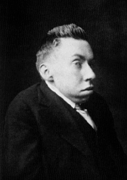
Randolph Bourne 1886-1918